NIST 800-171 Implementation Cost: The Itemized Breakdown for Small Defense Contractors
The government priced your implementation at zero. Your invoice folder will disagree. Here is where the money actually goes.
NIST 800-171 implementation cost is the money and labor required to put the 110 security requirements of NIST SP 800-171 Revision 2 in place before any CMMC Level 2 assessment happens. It is the largest and most variable part of a Level 2 budget, and it is the part the Department of Defense deliberately excluded from its published cost estimates, because the rule treats implementation as work contractors were already required to finish by December 31, 2017.
- DoD's cost analysis for the CMMC rule covers assessment and affirmation only. Implementation was scored as a sunk cost because DFARS 252.204-7012 required NIST 800-171 by the end of 2017.
- Market quotes for implementation run from a few thousand dollars to $250,000 or more. They diverge because vendors are pricing your starting gap, not the standard.
- The bill splits into two columns: line items you must pay a third party for, and line items that are labor a small contractor can do in-house.
- Scoping is the single biggest cost lever. Every asset you keep out of the CUI boundary removes controls, tooling, and assessor hours from the total.
- The documentation layer, meaning scoping, gap assessment, SSP, POA&M, SPRS score, policies, and evidence, is almost entirely in the do-it-yourself column.
Why DoD’s estimate for your implementation cost is zero
When DoD published the CMMC Program rule at 32 CFR Part 170 in October 2024, it included a Regulatory Impact Analysis with cost estimates by level. For a small entity pursuing Level 2 through a C3PAO, the estimate lands at roughly $105,000 to $118,000 across the three-year certification cycle.
If you have read the assessment-side breakdown of those numbers on this blog, you know those figures cover the assessment and the annual affirmations. What deserves its own article is the reasoning DoD gave for what it left out.
The Regulatory Impact Analysis states that the cost of implementing the security requirements themselves was not considered, because implementation is already required by FAR clause 52.204-21, effective June 15, 2016, and by DFARS clause 252.204-7012, which required NIST SP 800-171 implementation by December 31, 2017. In the government’s accounting, that money was spent eight years ago. CMMC only verifies it.
That is the single most important sentence in the entire cost conversation. The rule does not price the work. It prices the exam. If your shop signed contracts containing 252.204-7012 and did not fully implement the 110 requirements, the distance between where you are and where the clause says you already should be is the real bill. No government table estimates it, because officially it does not exist.
Why implementation quotes diverge so wildly
Search this topic and you will find first-year implementation figures ranging from around $5,000 for a small company with a simple IT environment to $250,000 or more for organizations investing in full remediation. One widely cited industry estimate puts small contractors at $75,000 to $130,000. Contractors on r/NISTControls report paying $30,000 for an assessment alone, with six figures per year in ongoing security maintenance.
These numbers are not contradicting each other. They are answering different questions. The standard is fixed: 110 requirements in NIST SP 800-171 Revision 2, assessed against the 320 assessment objectives in NIST SP 800-171A. What varies is the distance each company has to travel and the size of the environment making the trip. A 10-person machine shop that keeps CUI in one enclave with two workstations is not buying the same project as a 45-person engineering firm running CUI through its entire network.
So treat every quote you receive as a statement about your gap and your scope, not about the standard. Which means the way to control the cost is to control those two variables before anyone sends you a proposal.
The itemized bill: what you buy and what you build
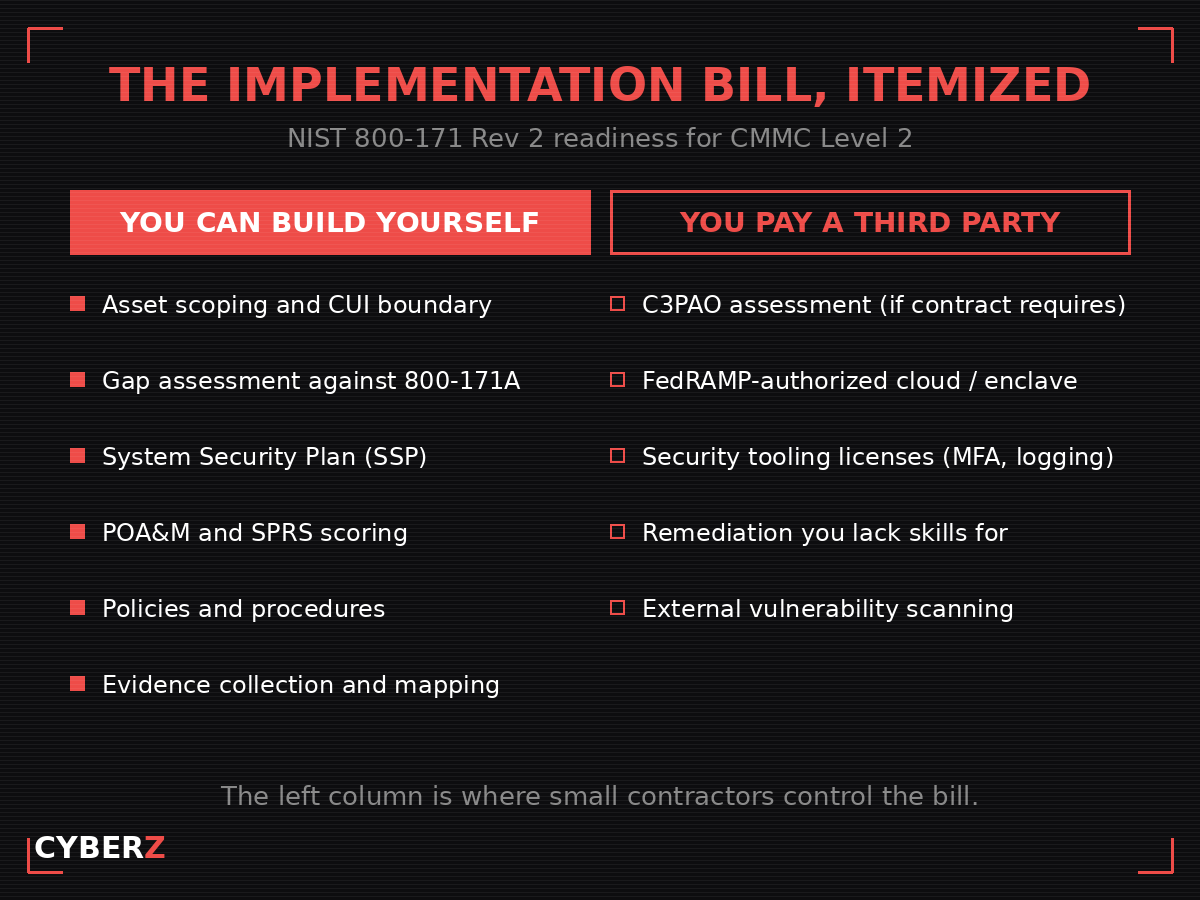
Here is the implementation bill broken into its actual line items, sorted by who has to be paid.
Scoping the CUI boundary (in-house)
Scoping is defined at 32 CFR § 170.19, which sorts every asset into five categories: CUI Assets, Security Protection Assets, Contractor Risk Managed Assets, Specialized Assets, and Out-of-Scope Assets. This is the first line item because it sets the size of every other line item. A workstation that never touches CUI and is documented as out of scope needs no new controls, no new tooling, and no assessor attention. The categorization itself is labor and judgment, not licenses. The CMMC Level 2 Asset Scoping Worksheet for NIST 800-171 ($47) walks the five categories asset by asset.
Gap assessment against 800-171A (in-house, mostly)
You can pay a consultant $10,000 to $25,000 for a gap assessment, and market quotes in that range are common. You can also run one yourself: NIST SP 800-171A is a free public document listing every objective an assessor will check. The self-run version costs internal hours instead of cash. Where a consultant earns their fee is judgment on ambiguous objectives and on evidence quality, which matters most if a C3PAO assessment is coming. For a self-assessment path, doing this in-house is entirely realistic.
The System Security Plan (in-house)
Requirement 3.12.4 makes the SSP mandatory, and it is the first document any assessor reads. Writing it is weeks of documentation labor, not a purchase. The structure is known and repeatable, which is why a CMMC Level 2 System Security Plan (SSP) Template ($77) exists; the content has to come from your environment. The full walkthrough is in the SSP template article.
POA&M and your SPRS score (in-house)
Scoring yourself against the DoD Assessment Methodology, posting the score to SPRS, and maintaining a Plan of Action and Milestones for open items is spreadsheet-and-judgment work. It is also legally loaded work, since the score is a representation to the government. The NIST 800-171 SPRS Score Workbook for CMMC Level 2 ($87) covers the 1, 3, and 5 point weighting and the floor.
Policies, procedures, and evidence (in-house)
Assessors verify through examine, interview, and test methods per 800-171A. That means written policies, written procedures, and collected evidence mapped to objectives. This layer is pure labor. It is also the layer contractors most often underestimate, because it feels like paperwork until an assessor asks for it.
Remediation and tooling (mixed)
Here real spend usually starts: multifactor authentication licensing, centralized logging, FIPS-validated encryption where 800-171 requires cryptography, endpoint protection, backup infrastructure. Some of it you may already own inside licenses you have, such as Microsoft 365 tiers, which is why the honest first step is an inventory of current tooling, not a shopping trip. Pay outside help for remediation where you genuinely lack the skills, not as a default.
Environment architecture (the big fork)
The largest single decision: bring your whole network into scope, or build a separate enclave where CUI lives. Enclaves carry their own costs, including FedRAMP-authorized cloud services where 252.204-7012 applies to cloud handling of covered defense information, but they shrink every downstream line item. This decision belongs before remediation, not after.
The C3PAO assessment (third party, fixed)
If your contracts require Level 2 certification rather than self-assessment, the assessment fee is the one unavoidable external line item. That side of the ledger, including DoD’s estimates and the proposed grant that would offset only this piece, is covered in the cost and grant breakdown. Timeline pressure ahead of the November 10, 2026 Phase 2 start is covered in the certification timeline article.
What a 12-person shop should actually do with this
First, scope before you spend. Run the five-category asset exercise and challenge every asset that drifted into scope by convenience. This is the cheapest cost reduction available anywhere in the program.
Second, build the documentation layer in-house. Scoping, gap assessment, SSP, POA&M, SPRS score, policies, evidence. All of it is labor a competent owner or IT lead can produce with structure and time. Reserve cash for the two things that genuinely require it: tooling you lack and remediation beyond your skills.
Third, sequence it. Scope, then gap, then SSP, then remediation, then evidence. Contractors who buy tools first routinely buy tools for assets that scoping would have removed.
The bottom line
DoD never estimated your implementation cost because, on paper, you finished implementing in 2017. The real number is set by two variables you control, your scope and your gap, and by how much of the documentation labor you keep in-house. The contractors getting crushed by six-figure quotes are usually paying consultants to do spreadsheet work, and the contractors getting burned by cheap quotes are usually skipping the evidence layer that assessments actually examine.
If you are doing the readiness work yourself ahead of a self-assessment or a C3PAO date, the CMMC Level 2 Readiness Kit: 5 NIST 800-171 Tools ($147) bundles the scoping worksheet, SSP template, SPRS workbook, POA&M tracker, and evidence tracker, which is the entire in-house column of the bill in one set.
Sources
- Cybersecurity Maturity Model Certification (CMMC) Program, Final Rule, 32 CFR Part 170, Federal Register, October 15, 2024
- Regulatory Impact Analysis, CMMC Program, 32 CFR Part 170, regulations.gov (Docket DOD-2023-OS-0063)
- DFARS 252.204-7012, Safeguarding Covered Defense Information and Cyber Incident Reporting, acquisition.gov
- FAR 52.204-21, Basic Safeguarding of Covered Contractor Information Systems, acquisition.gov
- NIST SP 800-171 Revision 2, Protecting Controlled Unclassified Information in Nonfederal Systems and Organizations, csrc.nist.gov
- NIST SP 800-171A, Assessing Security Requirements for Controlled Unclassified Information, csrc.nist.gov
- 32 CFR § 170.19, CMMC Scoping, ecfr.gov
Get CMMC deadline updates
Plain-English alerts when CMMC requirements, scoring, or deadlines change. Sent only when something actually moves.