CMMC Level 2 Certification Timeline: How Long It Really Takes, and Why June 2026 Is Late
About 1,000 of the roughly 80,000 contractors who need CMMC Level 2 are certified. Phase 2 starts November 10, 2026. The hard part is not finding an assessor. It is becoming ready in time.
The CMMC Level 2 certification timeline typically runs 6 to 12 months from gap analysis to a passed C3PAO assessment for an organization starting from a moderate baseline, plus the lead time to get the assessment scheduled. With CMMC Phase 2 beginning November 10, 2026, a contractor that has not started by mid-2026 is trying to compress roughly a year of work into about five months.
Key Takeaways
- Phase 2 begins November 10, 2026. A third-party C3PAO assessment becomes the default for Level 2 contracts that involve CUI.
- The realistic timeline is 6 to 12 months of preparation before the formal assessment, not counting remediation surprises.
- Roughly 1% of the DIB is certified. The Cyber AB reported about 1,000 organizations holding Level 2 against the ~80,000 expected to need it.
- The bottleneck is readiness, not assessors. 103 authorized C3PAOs and 759 assessors currently have capacity. Demand will spike as the deadline nears.
- Start with scope and an honest SPRS score. Both define how long everything after them takes.
How long does it take to get CMMC Level 2 certification?
For most defense contractors starting from a moderate security baseline, the answer is 6 to 12 months. That figure shows up consistently in DoD guidance and across the assessor community, and it covers the work that happens before a Certified Third-Party Assessment Organization (C3PAO) ever walks in the door.
The certification itself is a point in time. The timeline is everything that has to be true before that point. Level 2 is assessed against the 110 security requirements in NIST SP 800-171, and the companion document NIST SP 800-171A breaks those into 320 assessment objectives, each of which an assessor will examine, verify through interviews, or test. You do not pass by asserting the controls exist. You pass by producing evidence that each objective is met and operating.
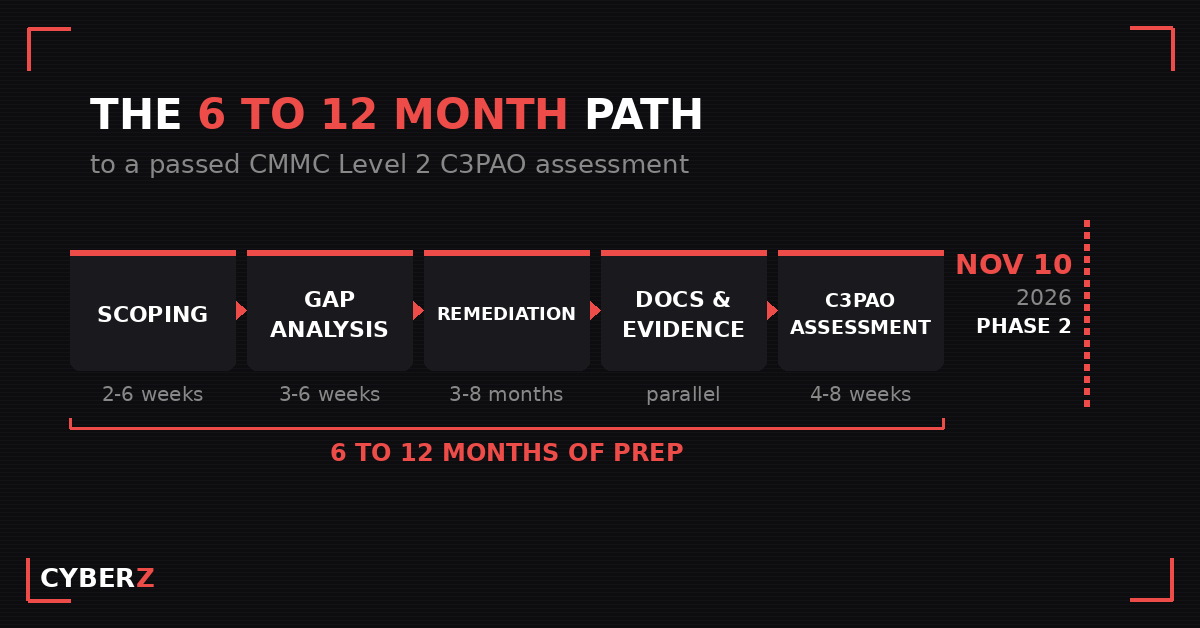
Here is where the months actually go.
| Phase | Typical duration | What it involves |
|---|---|---|
| Scoping | 2 to 6 weeks | Identify where CUI lives and sort assets into the five categories under 32 CFR 170.19. This sets the size of everything that follows. |
| Gap analysis | 3 to 6 weeks | Assess current state against all 110 controls and produce an honest SPRS score. This is where most contractors learn they are further behind than they thought. |
| Remediation | 3 to 8 months | Close the gaps. The long pole is usually technical: MFA everywhere, encryption with validated modules, logging, access control on CUI that leaves the perimeter. |
| Documentation | Runs in parallel | System Security Plan, POA&M, and the evidence artifacts that prove each of the 320 objectives. Documentation is not the last step. It is the deliverable. |
| C3PAO assessment | 4 to 8 weeks active | The formal examination, interviews, and testing. Plus the lead time to get on a C3PAO calendar in the first place. |
Add it up and the floor is six months for an organization that is already most of the way there. Anyone starting closer to zero is on the twelve-month end. Now hold that against the calendar. From mid-June 2026, November 10 is roughly five months away. The arithmetic does not work for a contractor that has not begun.
The real bottleneck is readiness, not the assessor queue
There is a popular story that says the problem is a shortage of assessors, that you will not be able to find a C3PAO in time no matter how ready you are. The current data does not support it.
As of the March 2026 Cyber AB Town Hall, there were 103 authorized C3PAOs and 759 certified assessors in the ecosystem, and about 178 new Level 2 certificates were issued that month. Model the capacity those assessors represent and there is slack in the system right now. The queue is not full today.
What is striking is the other number. To date, roughly 1,000 organizations have achieved Level 2 certification, against the DoD’s estimate that at least 80,000 across the Defense Industrial Base will need it.
of the Defense Industrial Base is certified at CMMC Level 2. About 1,000 organizations out of an estimated 80,000 that need it.
That gap is the real story. The constraint is not the supply of assessors. It is the supply of contractors who are actually ready to be assessed, and readiness is the part that takes 6 to 12 months and cannot be bought back at the last minute.
The slack will not last. As Phase 2 approaches, the contractors who have been preparing quietly all year will hit the queue at once, and assessors in defense-corridor regions are already booking further out than the rest of the country. The window where you can both finish your prep and find an open assessment date is the thing that is closing, and it closes from the readiness side first.
Do you need a C3PAO, or can you self-assess Level 2?
This is worth getting right, because it changes your timeline. Under the CMMC program rule, most contractors handling CUI will need a Level 2 certification assessment conducted by a C3PAO. A narrow set of Level 2 work permits self-assessment, generally where the CUI falls completely outside the National Archives CUI Registry’s Defense Organizational Index Grouping. For the typical subcontractor receiving technical data, drawings, or specifications flowed down from a prime, the default is C3PAO certification.
The honest framing for a small shop: assume you are in the C3PAO bucket until you have confirmed in writing that you are not. The clauses that decide this, including DFARS 252.204-7021, live in the solicitation. If your prime has sent a compliance demand and you are handling CUI, plan for the third-party route and the schedule it requires.
What happens if you are not certified by the deadline?
Failure here is not a fine you pay and move on. Under Phase 2, a required CMMC status has to be on record at the time of contract award. No status, no eligibility. You do not get to bid, or your prime cannot flow work to you, on contracts that carry the requirement.
There is a second, quieter risk. A signed self-attestation that overstates your posture is a representation to the government, and the Department of Justice has spent the past two years using the False Claims Act to pursue contractors whose SPRS scores did not match reality. A wrong score is not just an IT problem. It is a legal statement. The safe move is the slow one: an accurate score, backed by evidence, on a realistic timeline.
How much does it cost, and is CMMC 2.0 even final?
Yes, it is final. The 32 CFR program rule took effect in December 2024, and the acquisition rule that puts CMMC clauses into contracts became effective November 10, 2025. The phased rollout is real and dated, not a proposal that might slip.
Cost varies widely with size and starting posture. A small contractor with a clean, well-scoped environment spends far less than a multi-site operation with sprawling CUI. The assessment fee is only one line. The larger cost, and the one that drives the timeline, is the remediation and documentation work in the months before the assessment. Spending money does not compress that work below its floor. Starting earlier does.
What to do in the next five months
If you are starting the clock now, the sequence matters more than the speed.
- Scope first. Map where CUI actually lives and categorize your assets under 32 CFR 170.19. An oversized scope is the most expensive mistake you can make, and it inflates every phase after it.
- Get an honest SPRS score. Score yourself against all 110 controls before anyone else does. The number tells you whether you are on the six-month path or the twelve-month one.
- Build the SSP and POA&M as you go. Documentation is the deliverable an assessor reads. Treat it as the work, not the paperwork after the work.
- Collect evidence per objective. All 320 assessment objectives need artifacts. Start the folder now, not the week before.
- Get on a C3PAO calendar early. Capacity is open today. It will not be in Q4. Booking the date also forces the internal deadline that prep tends to need.
The contractors who make November are not the ones who move fastest in October. They are the ones who started scoping in summer.
If you are starting that clock now, the CMMC Level 2 Readiness Kit: 5 NIST 800-171 Tools ($147) packages the scoping worksheet, SPRS score workbook, SSP template, POA&M tracker, and evidence tracker into the exact sequence above, so the five months you have left go toward building readiness instead of figuring out what the assessment expects. It is built for the contractor doing this without a full-time compliance hire.
Sources
- CMMC program rule, 32 CFR Part 170, and acquisition rule effective November 10, 2025 (DFARS 252.204-7021). U.S. Department of Defense / eCFR.
- CMMC Phase 2 implementation date of November 10, 2026. U.S. Department of Defense.
- NIST SP 800-171 (110 security requirements) and NIST SP 800-171A (320 assessment objectives). National Institute of Standards and Technology.
- C3PAO count (103), certified assessor count (759), monthly Level 2 certificates (~178), and approximately 1,000 total Level 2 certifications. Cyber AB, March 2026 Town Hall.
- Estimate of ~80,000 DIB organizations requiring Level 2 certification. U.S. Department of Defense.
- DOJ Civil Cyber-Fraud Initiative False Claims Act settlements involving NIST SP 800-171 self-assessment scores. U.S. Department of Justice press releases.
Get CMMC deadline updates
Plain-English alerts when CMMC requirements, scoring, or deadlines change. Sent only when something actually moves.