CMMC SSP Template: What NIST 800-171 Control 3.12.4 Requires (and What a C3PAO Actually Reads)
If you sell to the Department of Defense and your contract touches Controlled Unclassified Information (CUI), you need a System Security Plan. Search “CMMC SSP template” and you will find dozens of blank Word files promising to make the requirement disappear. A template helps you start. It is not the thing being assessed.
The thing being assessed is whether your SSP accurately describes how your organization implements each security requirement, and whether an assessor can verify those claims. This guide walks through what the SSP requirement actually is under CMMC Level 2, what a Certified Third-Party Assessment Organization (C3PAO) looks for when it opens the document, and the structure that survives a real assessment. Every claim below points back to a primary source.
The SSP is a control, not a formality
Under CMMC Level 2, the SSP requirement is control CA.L2-3.12.4, drawn directly from NIST SP 800-171. The control requires you to develop, document, and periodically update system security plans that describe the system boundary, the operational environment, how each security requirement is implemented, and the relationships with or connections to other systems.
One baseline detail you cannot get wrong: CMMC Level 2 is assessed against NIST SP 800-171 Revision 2, which is 110 security requirements across 14 control families. NIST published Revision 3 in May 2024, and it reorganizes the framework, but it is not the CMMC assessment baseline. DoD still maps Level 2 to Rev 2 under a class deviation. If you build your documentation to Rev 3 today, you risk showing requirements as unmet against the standard your assessor is actually using. Build to Rev 2.
The detail that matters most. DoD’s assessment guidance for 3.12.4 states that the absence of a system security plan results in a finding that the assessment could not be completed, and that it constitutes noncompliance with DFARS clause 252.204-7012. In plain terms: no SSP is not a low score. It is a stop.
Why the SSP is the first thing an assessor opens
In a CMMC Level 2 assessment, the SSP is typically the first document a C3PAO requests. It is the map for everything that follows. It tells the assessor what is inside your assessment scope, what you claim to have implemented, and where to find the evidence. A clear, accurate SSP sets the tone for a clean assessment. A vague or inaccurate one invites scrutiny on every control that follows, because the assessor can no longer take your claims at face value.
That is the practical reason templates alone fall short. A blank template gives you the right headings. It cannot tell the assessor how multi-factor authentication is actually enforced on your network, which is the part being verified.
What goes in a CMMC Level 2 SSP
A System Security Plan that holds up is built around your environment, not around generic boilerplate. NIST SP 800-18 is the long-standing reference for SSP structure, and most workable CMMC plans follow its shape. At minimum, the document needs to cover the following.
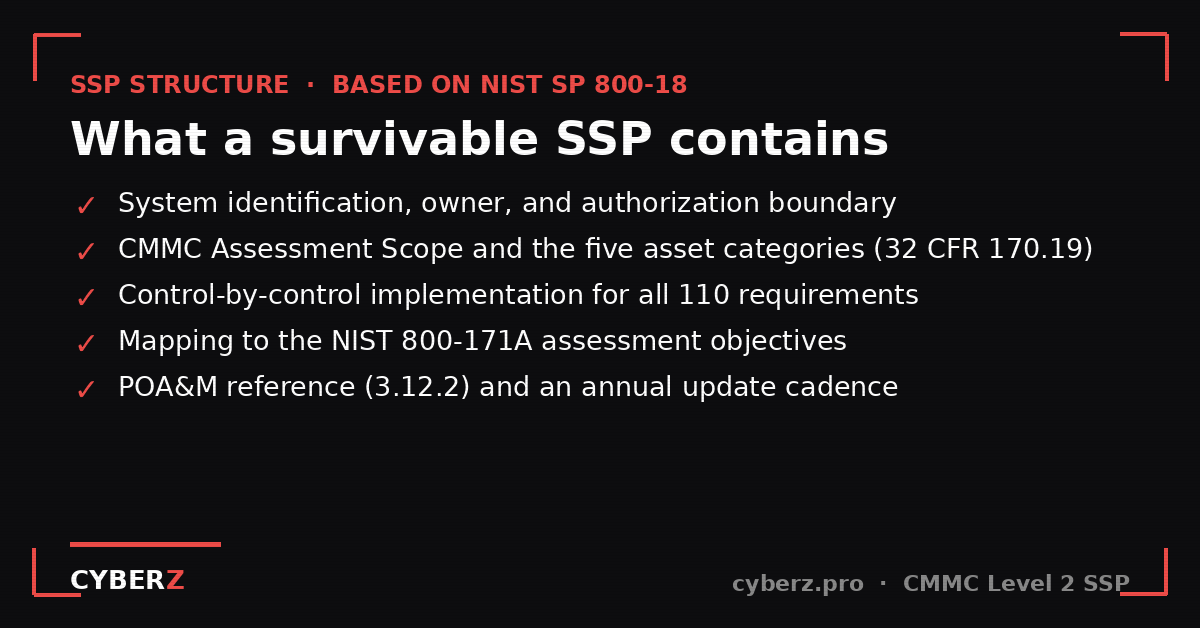
- System identification and the authorization boundary. Name the system, its owner, and exactly what the boundary includes.
- The CMMC Assessment Scope. Categorize every asset using the five categories defined in 32 CFR 170.19 (see below).
- Control-by-control implementation. How each of the 110 requirements is met in your environment.
- Mapping to the assessment objectives. Each control maps to the determination statements in NIST SP 800-171A.
- Responsible roles, ESPs, and external connections. Who owns what, and which external service providers or connected systems are in play.
- POA&M reference and update cadence. A pointer to your Plan of Action and Milestones, and how often the SSP is refreshed.
The 110 controls, mapped to 800-171A
The most common template failure is describing a control at the level of the control statement. Restating “the organization limits system access to authorized users” tells an assessor nothing. For each requirement, your SSP has to explain what you do, how you do it, and who is responsible, in enough detail that the assessor can trace it to the determination statements in NIST SP 800-171A. 800-171A is the companion publication assessors use to decide whether a requirement is MET or NOT MET. If your SSP is written so a stranger could verify each objective, you are most of the way there.
Scope and the system boundary
CMMC scope is defined in 32 CFR 170.19, which sorts assets into five categories: CUI Assets, Security Protection Assets, Contractor Risk Managed Assets, Specialized Assets, and Out-of-Scope Assets. Your SSP must define the boundary, and the boundary has to match reality. The fastest way to lose an assessor’s confidence is a network diagram and asset inventory that do not line up with what the SSP claims is in scope. Scope decisions made before you write the SSP determine how large and how expensive the rest of the effort becomes.
SSP vs POA&M: what belongs where
These two documents are often confused, and the distinction matters at assessment time. The SSP describes your current state: what is implemented now. The POA&M (control 3.12.2) tracks what is not yet met and your concrete plan to close each gap.
| Document | What it captures |
|---|---|
| SSP (3.12.4) | Current implementation of all 110 requirements, scope, boundary, responsible roles |
| POA&M (3.12.2) | Open gaps, remediation steps, owners, and target dates for items not yet MET |
A nuance worth getting right: not every gap can be deferred to a POA&M. CMMC conditional certification requires meeting a minimum threshold (88 of the 110 requirements, with the remaining items eligible for a POA&M and a 180-day window to close them), and certain requirements cannot be placed on a POA&M at all. The SSP and POA&M have to tell a consistent story. If a control is on the POA&M, the SSP should reflect that it is not yet fully implemented.
Five ways an SSP fails an assessment
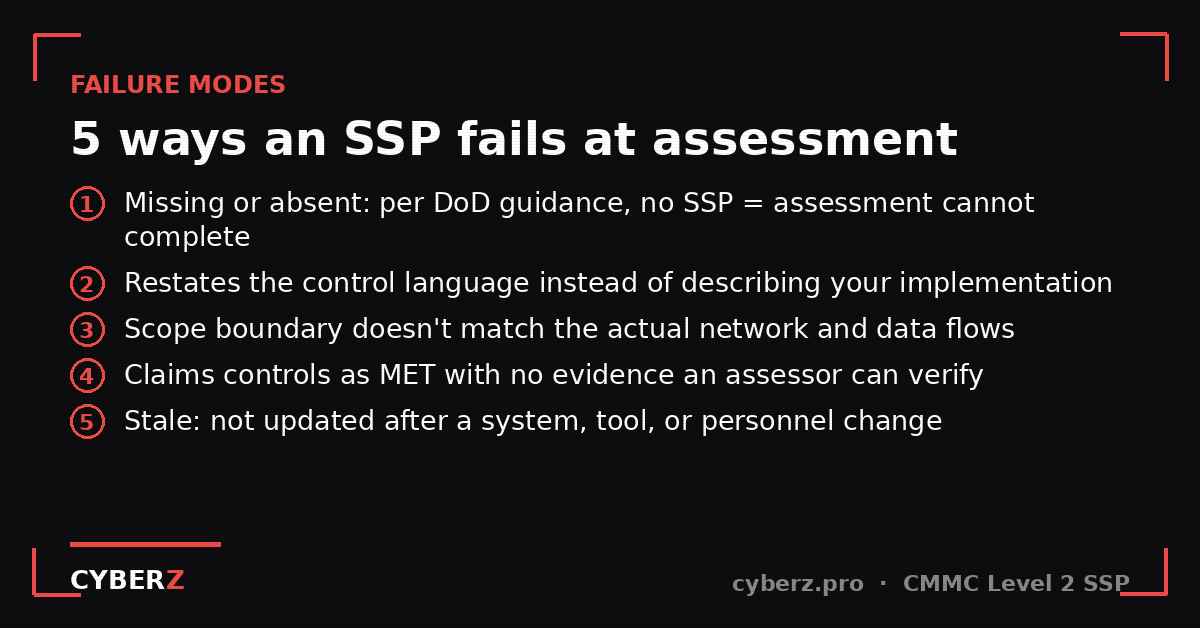
- It is missing or absent. Per DoD guidance, this stops the assessment outright.
- It restates the control language instead of describing your implementation.
- The scope boundary does not match the actual network, data flows, and asset inventory.
- It claims controls as MET with no evidence an assessor can verify.
- It is stale, not updated after a system, tool, or personnel change.
Keep it current
An SSP is a living document. Update it at least annually, and whenever your systems, tools, or responsibilities change. An assessor who sees a plan last touched two years ago, against a network that has clearly evolved, will reasonably doubt that the rest of the document reflects reality. Build a habit of revising the SSP whenever the environment moves.
A faster starting point
If you are staring at a blank template trying to reverse-engineer what 3.12.4 expects, you are doing the hard part backwards. The structure, the 800-171A mapping, and the scope categorization are the same for every Level 2 contractor. What changes is your environment.
The CMMC Level 2 System Security Plan (SSP) Template ($77) gives you the full structure already mapped to the 110 Rev 2 requirements and the 800-171A objectives, so you are filling in your environment rather than building the scaffolding from scratch. If you also need scoping, scoring, and evidence tracking in one place, the CMMC Level 2 Readiness Kit ($147) bundles the SSP template with four more tools for contractors building the whole package ahead of a C3PAO date.
Sources
- NIST SP 800-171 Rev 2, control 3.12.4 (System Security Plan); 3.12.2 (Plan of Action). National Institute of Standards and Technology.
- CMMC Assessment Guide – Level 2, CA.L2-3.12.4. DoD / Cyber AB (DIB SCC CyberAssist).
- DoD Assessment Methodology, 3.12.4 guidance: absence of an SSP precludes assessment completion; noncompliance with DFARS 252.204-7012.
- 32 CFR Part 170.19 – CMMC scoping and the five asset categories.
- NIST SP 800-171A – assessment objectives. NIST SP 800-18 – guide for system security plan structure.
- CMMC Level 2 baseline aligned to NIST SP 800-171 Rev 2 (DoD class deviation); Rev 3 published May 2024, not the current assessment standard.