OpenAI's $1 Billion Daybreak Program: What a Small Business Actually Gets
The community bank on your street can now apply for subsidized frontier AI cyber defense. The CPA firm that audits it cannot. The public hospital qualifies through a new pilot. The private dental practice two blocks away does not. The line OpenAI drew on September 3 runs straight through Main Street, and it is worth knowing which side of it your firm is on.
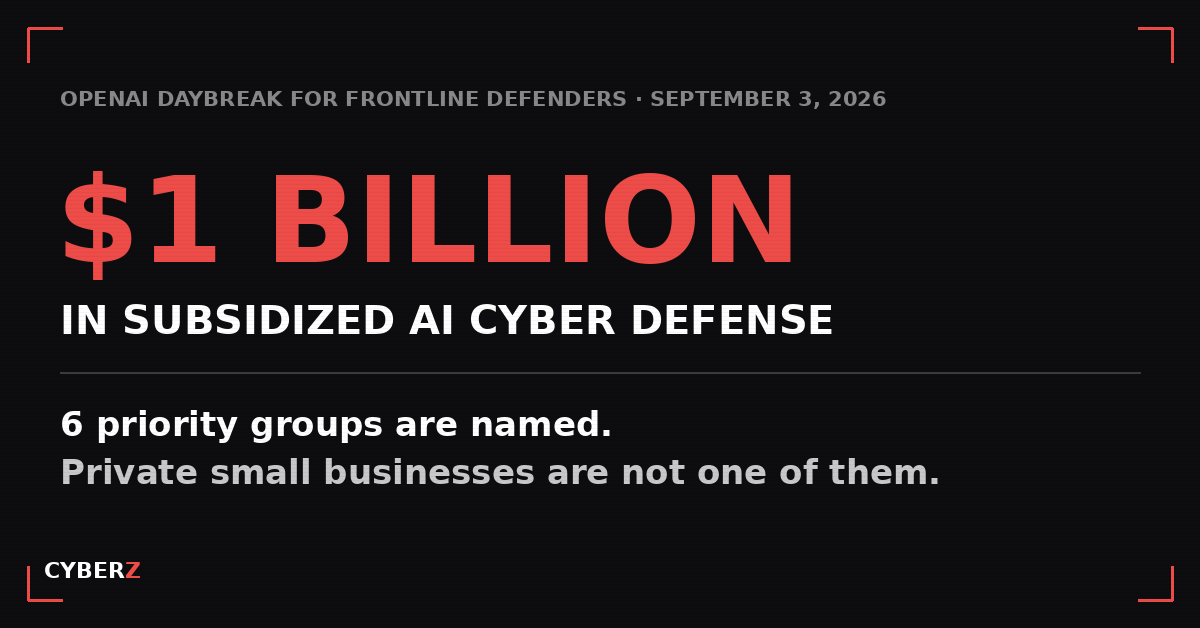
Daybreak for Frontline Defenders is a program OpenAI announced on September 3, 2026 that commits $1 billion in subsidized access to its Daybreak cyber models, plus training, technical support and partnerships, targeted to be consumed over the next six months. It prioritizes operators of essential services: water and wastewater systems, electric grid operators, state and local governments, community and regional banks, nonprofits and open-source maintainers. Private small businesses are not a named priority. For them, the announcement matters for a different reason: the same models are being pushed into more than 35 security products and services that small firms already buy through their vendors and MSPs.
- OpenAI committed $1 billion in subsidized Daybreak access on September 3, 2026, targeted to be spent over six months, starting in the United States under the "Daybreak for America" banner.
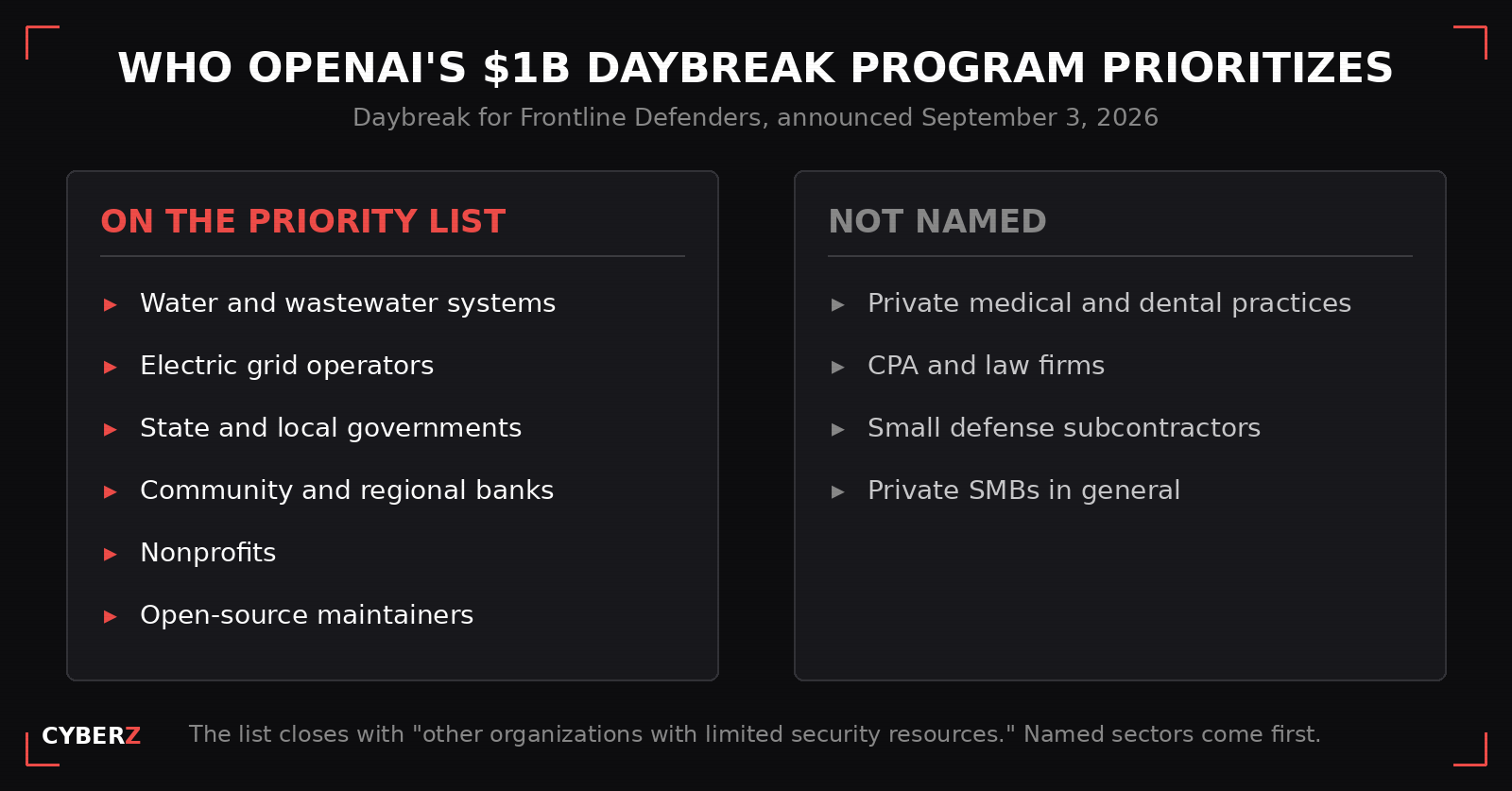
- The named priority groups are water and wastewater systems, electric grid operators, state and local governments, community and regional banks, nonprofits and open-source maintainers. The list closes with "other organizations with limited security resources," but the named sectors come first.
- Healthcare is on the list only in its public form. The MS-ISAC pilot reaches public hospitals and public-sector health systems. A private practice is not the target.
- The route to a private small firm is the Daybreak Defense Network: more than 35 partner products and partner-operated services that embed OpenAI's cyber models in tools defenders already use. Your MSP or security vendor is the delivery mechanism, not an application portal.
- That creates two new vendor due-diligence questions and changes nothing about your own obligations. The controls HIPAA, the FTC Safeguards Rule and NIST SP 800-171 require from your firm are still yours to run.
What OpenAI announced on September 3
OpenAI introduced Daybreak for Frontline Defenders as a global initiative with three parts. The first is the money: $1 billion in subsidized access to Daybreak cyber models and products, along with training, technical support and partnerships, with OpenAI targeting the commitment to be consumed over the next six months. The second is “Daybreak for America,” which consolidates OpenAI’s U.S. work on protecting essential services and adds a pilot with the Multi-State Information Sharing and Analysis Center, or MS-ISAC. The third is the Daybreak Defense Network, where partners announced more than 35 products and partner-operated services that build OpenAI’s cyber models into tools enterprise defenders already use.
The announcement lands one week after the open letter. On August 27, OpenAI published “A call for collective action on cyber defense,” co-signed by more than 150 organizations, warning that AI-enabled attacks will become far more widespread and sophisticated in the coming months. We covered what that letter asks of a small regulated firm in our breakdown of the AI cyber defense letter. The letter was the argument. Daybreak for Frontline Defenders is the first large check written against it.
Some context on the underlying program helps. Daybreak launched earlier in 2026 as a controlled-access environment for verified public and private sector defenders. Daybreak Blue supports common defensive work using OpenAI’s mainline models. Daybreak Red gives approved organizations access to specialized cyber models for more sensitive and technically demanding work. OpenAI says thousands of defenders across 2,000 approved organizations and workspaces already use it. The September 3 commitment does not open that door to everyone. It subsidizes the door for a specific set of defenders.
Who the priority list names, and who it does not
OpenAI’s own wording is precise. The commitment prioritizes “operators of essential services—including water and wastewater systems and electric grid operators, alongside state and local governments, community and regional banks, nonprofits, open-source maintainers, and other organizations with limited security resources.”
Six groups are named. The seventh clause is a catch-all, and a private small business could in principle argue its way into it. But a subsidy program with a six-month spend target and named priority sectors is going to spend where it said it would. The realistic reading for a 20-person private firm is simple: this money is not aimed at you.
The program follows a pattern OpenAI has already run once. After recent attacks on U.S. water systems, OpenAI offered affected states and utilities up to $1 million each in no-cost API credits, Daybreak access and technical assistance. Teams used it to review code and configurations, validate findings, develop patches and confirm fixes while systems stayed operational. Daybreak for Frontline Defenders scales that model from emergency response to standing program.
There is also a scale detail worth registering. OpenAI has been convening utility companies directly, and its second gathering brought together participants from 40 states and the District of Columbia that collectively serve more than half of the U.S. population. That is where the hands-on attention is going.
The healthcare detail worth reading twice
If you run a medical or dental practice, the word “healthcare” in this announcement can mislead. Healthcare appears through MS-ISAC, which provides threat intelligence, incident response and shared defenses to thousands of public-sector organizations, including public hospitals, K-12 schools, utilities and law enforcement. The new pilot pairs Daybreak access with guided training for an initial group of public-sector and water-system defenders.
Public hospitals and regional public health systems sit inside that community. A private practice does not. The same regulated data, the same OCR enforcement exposure, a different side of the line. Nothing about that is scandalous; the program targets essential public services, and that is a defensible place to start. But a practice owner who reads “healthcare” in the coverage and assumes help is coming should not.
The same logic applies in the defense supply chain. Community banks are named because they are essential services. A small machine shop holding controlled unclassified information on a DoD subcontract is not, even though the data it protects arguably matters as much to national security as the deposits at a regional bank. The subsidy follows the essential-services definition, not the sensitivity of the data.
How the capability reaches a private small firm anyway
The part of the announcement that actually touches a private SMB is the Daybreak Defense Network. OpenAI’s partners announced more than 35 products and partner-operated services that bring Daybreak cyber models into existing security tools and workflows.
The access model matters. When OpenAI launched the partner program in June 2026, it described it this way: participating security vendors can use GPT-5.5 with Trusted Access for Cyber, OpenAI’s primary model for defensive cybersecurity workflows, inside the products and services they provide to customers, while direct model access stays with the participating partners. Customers get the capability. Vendors hold the keys.
For a small firm, that means the question is not “how do I apply for Daybreak.” You almost certainly will not, and OpenAI has not published pricing for direct Daybreak access anyway; the program runs on verification and, for the frontline groups, subsidy. The question is which of the tools you already pay for is about to have a frontier cyber model inside it. Your endpoint protection, your managed detection service, your vulnerability scanner, or the stack your MSP runs on your behalf.
That is genuinely good news for small-firm defense. It is also a change in your vendor risk picture, because a new class of capability is entering your environment through the side door, on your vendors’ schedule rather than yours.
Two questions to ask your MSP or security vendor now
We walked through the general framework in our AI vendor due diligence guide. Daybreak sharpens it to two specific questions worth sending this month.
First: are you, or the tools you deploy for us, part of the Daybreak Defense Network or any equivalent AI-assisted security program, and what does the model see? If your MSP’s tooling now routes telemetry, configurations or code through an AI model, you need to know what data leaves your environment, under what agreement, and whether any of it includes protected health information, customer nonpublic personal information or controlled unclassified information. A HIPAA-covered practice needs its business associate agreement to cover the flow. A defense subcontractor needs to know whether CUI is touching a commercial model pipeline at all.
Second: when the AI finds something, who validates it and who acts? OpenAI’s own materials describe the loop as identify, validate, prioritize, fix. Ask your vendor where the human sits in that loop for your account, and what their turnaround commitment is when the model flags something critical in your environment. An AI-assisted finding that sits in a queue for three weeks protects nobody, and a patch pushed to your production systems with no human review is its own risk.
Neither question is hostile. A good MSP will have answers, and the ones who adopted these tools thoughtfully will be glad you asked. If you get a blank stare, that tells you something too. Our AI Acceptable Use Policy Kit ($47) includes the vendor-facing AI questions alongside the internal policy templates.
What stays your job no matter who gets the subsidy
The $1 billion changes who has frontier tooling. It changes nothing about who holds the obligations.
If you are a covered entity or business associate, the HIPAA Security Rule still requires your own risk analysis under 45 CFR 164.308(a)(1)(ii)(A), and OCR does not accept “our MSP uses advanced AI” as a substitute for one. The HIPAA Security Risk Assessment Tool ($57) exists for exactly that gap. If you fall under the FTC Safeguards Rule, multi-factor authentication under 16 CFR 314.4(c)(5) and vendor oversight under 314.4(f) remain your program to run. If you hold CUI, NIST SP 800-171 Rev 2 is still the standard your SPRS score attests to, including least privilege under 3.1.5 and MFA under 3.5.3, and your annual affirmation is still signed by your executive, not your vendor’s.
There is a quiet risk in announcements like this one: the sense that the adults have arrived and the problem is being handled at a higher level. For the six named groups, some of it now is. For everyone else, the attackers got the same news you did. The letter OpenAI and 150 other organizations signed in August says AI-enabled attacks become far more widespread within months. The subsidy hardens the water systems and the county networks. It does not harden your practice.
The bottom line
Daybreak for Frontline Defenders is a real commitment aimed at real gaps, and the named recipients, from water utilities to community banks, are sensible choices. A private small business is not on the list and should not wait for a version of the program that includes it. The capability will arrive anyway, inside the commercial security tools and MSP stacks the market already sells you, which makes vendor due diligence the live issue: know whether AI-assisted tooling is entering your environment, what data it sees, and who validates what it finds. And keep running the controls the law already assigns to you, because no part of the $1 billion pays for those.
Sources
- OpenAI, “Daybreak for Frontline Defenders: $1B to protect essential services,” September 3, 2026
- OpenAI, “A call for collective action on cyber defense,” August 27, 2026
- OpenAI, “Daybreak: Tools for securing every organization in the world,” June 22, 2026
- U.S. Department of Health and Human Services, HIPAA Security Rule, 45 CFR 164.308
- Federal Trade Commission, Standards for Safeguarding Customer Information, 16 CFR Part 314
- NIST, SP 800-171 Rev 2, Protecting Controlled Unclassified Information in Nonfederal Systems