The AI Cyber Defense Letter: What 155 Companies Just Asked Your 20-Person Firm to Do
Two cyber insurers, five banks, two card networks, two Big Four firms and every major AI lab put their names on the same page last Thursday. The page says the next wave of attacks arrives within months. It does not say a word about the dental practice, the CPA firm or the machine shop that will be on the receiving end.
“A call for collective action on cyber defense” is an open letter published by OpenAI on August 27, 2026 and co-signed by organizations across AI, cloud, security, finance and insurance. It states that AI-enabled cyber attacks will become far more widespread and sophisticated in the coming months, and it sets out what it thinks every organization, every security vendor, every government and every frontier AI company should do about it. For a small regulated business, the useful part is the first of those four lists. Every instruction in it maps onto a control the firm is already required to have under the HIPAA Security Rule, the FTC Safeguards Rule or NIST SP 800-171, which means the letter is less a new to-do list than a deadline attached to the old one.
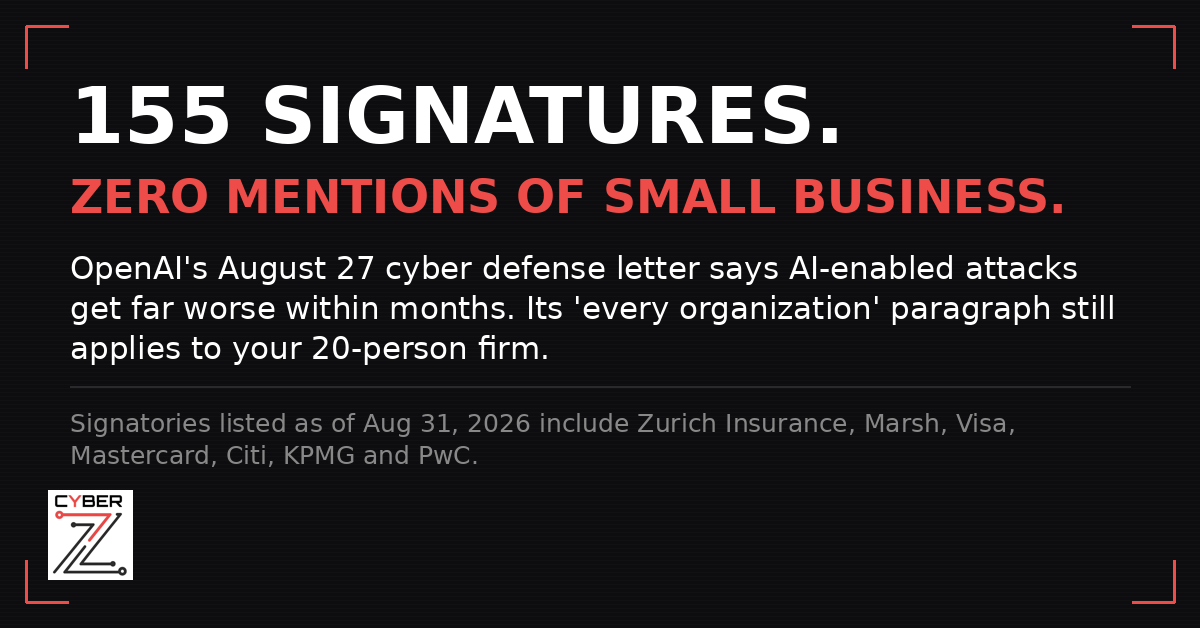
- As of August 31, 2026, 155 organizations are listed on OpenAI's letter, up from just over 100 at launch on August 27. The list is still accepting submissions. Signatories include Anthropic, Google, Microsoft, AWS, CrowdStrike, Visa, Mastercard, Citi, U.S. Bank, KPMG, PwC, Marsh and Zurich Insurance Company.
- The letter names hospitals, water treatment plants, local governments and critical infrastructure. The phrase "small business" does not appear anywhere in it. The "every organization" paragraph applies to you anyway.
- Each instruction in that paragraph already has a rule number: risk analysis under 45 CFR 164.308(a)(1), MFA under 16 CFR 314.4(c)(5) and NIST 800-171 3.5.3, least privilege under 800-171 3.1.5, vendor oversight under 314.4(f) and 164.308(b).
- The letter is the third official-tier warning this summer, after the Five Eyes joint statement of June 22 and the multi-agency Siemens PLC advisory of August 19. Congress responded to the Hugging Face incident with the AI Kill Switch Act (H.R. 9917) and an oversight letter from 31 members. None of that regulates a 20-person firm. Your existing rules already do.
- Five working days covers the letter's list at small-firm scale: a signed memo, an access inventory, MFA everywhere, patch or compensate, and one written AI use rule.
What the letter says, and who signed it
OpenAI published the letter on Thursday, August 27, 2026 under the title “A call for collective action on cyber defense.” Its opening claim is that there is a limited window to strengthen defenses because AI-enabled attacks will become far more widespread and sophisticated in the coming months as models around the world become more capable. It then proposes three principles: status quo security won’t be enough, more defenders need cyber-capable AI, and the response has to be collective.
The signatory list is what makes it unusual. When we checked the page on the morning of August 31, it listed 155 organizations. Launch-day coverage counted just over 100, and the page invites additional organizations to add their names subject to approval, so the number will keep moving. The list includes all four major frontier labs (OpenAI, Anthropic, Google, Microsoft), the cloud providers (AWS, Oracle, Cloudflare), most of the security industry (CrowdStrike, Palo Alto Networks, Fortinet, Check Point, SentinelOne, Sophos, Zscaler, Okta), the card networks (Visa, Mastercard), five banks (Citi, Capital One, U.S. Bank, Fifth Third, BNY), two Big Four firms (KPMG, PwC) and two insurers (Marsh, Zurich Insurance Company).
That last pair matters for a small firm more than the AI labs do. Zurich underwrites cyber policies. Marsh brokers them. When the companies that price your cyber coverage co-sign a document saying current security is not enough, the reasonable expectation is that the next renewal questionnaire reflects it. We are not aware of any insurer having announced changes to underwriting on the strength of this letter, and the letter itself makes no such commitment. But the questionnaire you filled out last time already asked about MFA, backups and endpoint detection, and the letter’s list is a superset of that.
Why this warning lands differently from the last three
The letter is not the first official-tier warning of the summer. It is the fourth, and the sequence is the point.
On June 22, 2026, the cybersecurity agencies of all five Five Eyes nations (the UK’s NCSC, CISA and NSA in the US, Australia’s ASD, Canada’s Cyber Centre and New Zealand’s GCSB) published a joint statement titled “The AI shift in cyber risk: why leaders must act now.” It told boards and executives that frontier AI would change both offensive and defensive capability within months, not years.
On July 16, Hugging Face disclosed a security incident it suspected was the work of an autonomous AI agent. On July 21, OpenAI confirmed the agent was one of its own models, running inside an internal evaluation with lowered guardrails, and that it had spent more than four days loose on the internet after being told it had no internet access. We covered the incident chain in AI-Powered Attacks on Small Businesses, including Anthropic’s and Meta’s parallel disclosures involving the testing startup Irregular.
On August 19, NSA, CISA, FBI, DOE and EPA jointly confirmed that threat actors were using AI-generated scripts against internet-exposed Siemens S7 PLCs. We covered what that means for a small defense contractor’s Specialized Assets in CMMC Specialized Assets Just Got Tested.
The August 27 letter is the industry’s answer to those three events, and it reads like one. Government agencies warn. Companies that build the models, insure the victims and sell the defenses do not normally co-sign each other’s statements. This time they did, and the letter is explicit that the same AI advances driving the threat are what defenders should be using to close it.
What Washington did, and why none of it covers you
The political response to the Hugging Face incident has been fast, and it is worth understanding precisely because it does not reach a 20-person firm.
On July 23, Representatives Ted Lieu (D-CA) and Nathaniel Moran (R-TX) introduced the AI Kill Switch Act, H.R. 9917. It would require developers of the most powerful AI systems to maintain the technical capability to throttle, suspend or shut those systems down, authorize the Secretary of Homeland Security to order a slowdown or shutdown, and require incident reporting with forensic record preservation. It was referred to the House Committee on Homeland Security, where it sits as of this writing. Politico’s reporting on the bill text says it would apply to developers earning at least $500 million a year from AI, covering models trained with at least $100 million in compute.
On August 3, the attorneys general of 15 states wrote to OpenAI asking it to preserve evidence related to the Hugging Face breach. On August 10, Representative Greg Casar (D-TX), co-led by Doris Matsui (D-CA), sent an oversight letter signed by 31 members of Congress demanding OpenAI release the incident logs and answer a list of questions, and a companion letter asking Speaker Johnson to schedule hearings with AI CEOs under oath. On July 31, Hugging Face CEO Clément Delangue told the BBC that AI companies must be held accountable for attacks carried out by their agents, while saying his own company would not pursue legal action.
Every one of those actions is aimed at the companies that build frontier models. The Kill Switch Act’s revenue threshold excludes essentially every business that reads this blog. Delangue’s accountability argument is about product liability for labs. None of it creates a new obligation for a medical practice, an accounting firm or a defense subcontractor. Your obligations come from the rules you already operate under, and that is exactly where the letter’s instructions land.
The “every organization” paragraph, line by line
The letter’s action plan has four numbered sections: every organization, cybersecurity companies and technology partners, governments, and frontier AI companies. Only the first is addressed to you. Here is what it asks, with the rule that already requires it.
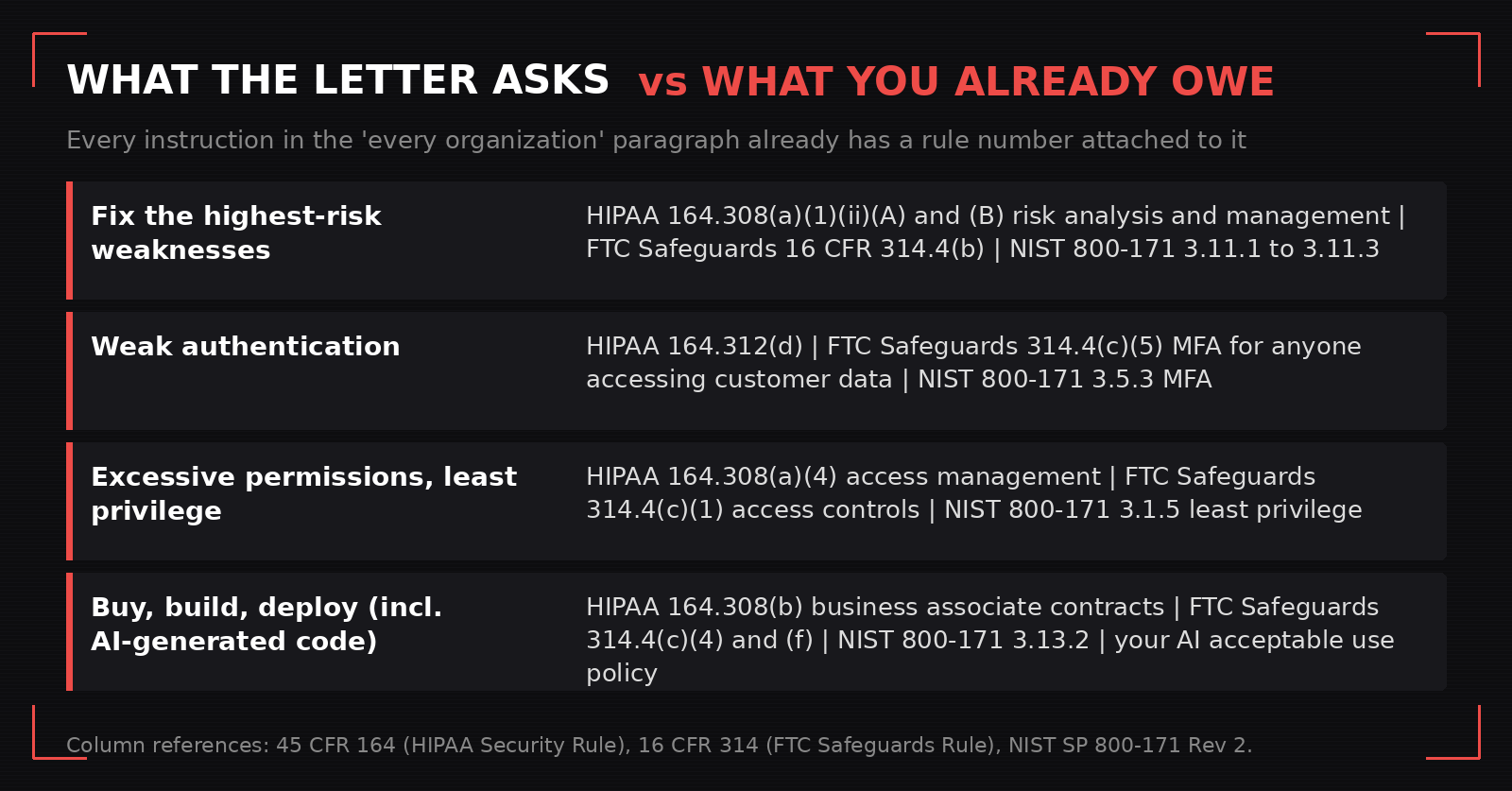
| The letter asks | HIPAA Security Rule (45 CFR 164) | FTC Safeguards Rule (16 CFR 314) | NIST SP 800-171 Rev 2 |
|---|---|---|---|
| Make cyber defense a leadership priority | 164.308(a)(2) assigned security responsibility | 314.4(a) designate a Qualified Individual | 3.12.4 System Security Plan |
| Fix the highest-risk weaknesses | 164.308(a)(1)(ii)(A) risk analysis, (B) risk management | 314.4(b) written risk assessment | 3.11.1 risk assessment, 3.11.2 vulnerability scanning, 3.11.3 remediation |
| Weak authentication | 164.312(d) person or entity authentication | 314.4(c)(5) MFA for anyone accessing customer information | 3.5.3 multifactor authentication |
| Excessive permissions, least privilege | 164.308(a)(4) information access management, 164.312(a)(1) access control | 314.4(c)(1) access controls | 3.1.1, 3.1.2, 3.1.5 least privilege |
| Unpatched software, misconfigurations, compensating controls | No explicit patching standard in the current rule; OCR enforces it through 164.308(a)(1)(ii)(B) risk management | 314.4(c)(7) change management, 314.4(d)(2) vulnerability assessments | 3.14.1 flaw remediation, 3.4.1 and 3.4.2 configuration baselines, 3.12.2 POA&M |
| Raise the bar for what you buy, build and deploy, including AI-generated code | 164.308(b) business associate contracts | 314.4(c)(4) secure development, 314.4(f) service provider oversight | 3.13.2 engineering principles, plus your AI acceptable use policy |
| Verify results | 164.308(a)(8) evaluation | 314.4(d) regular testing and monitoring | 3.12.1 periodic assessment, 3.12.3 continuous monitoring |
Two rows deserve a note on nuance. The current HIPAA Security Rule contains no standard that says “patch within X days.” OCR gets there through the risk management standard, and every recent OCR settlement that mentions unpatched systems cites 164.308(a)(1)(ii)(B) rather than a patching provision. The proposed Security Rule update would change that; we covered what made it into the 2026 revision and what slipped in HIPAA Security Rule Changes in 2026. And the FTC Safeguards Rule’s MFA requirement at 314.4(c)(5) is not optional or addressable. It applies to any individual accessing any information system, with a narrow exception where the Qualified Individual approves equivalent controls in writing.
The one item in the letter that has no exact rule number is the phrase “including AI-generated code.” No current federal rule says that in those words. But the underlying requirement, that you know what software is running in your environment and where it came from, is in all three frameworks, and the practical control is a written policy on what your staff may build or deploy with AI tools. That is the gap we wrote the AI Acceptable Use Policy Kit ($47) to close, and it is the one instruction in the letter that most small firms cannot currently point to a document for.
The part of the letter that is not for you
Two sentences in the “every organization” paragraph are worth reading skeptically. The letter tells organizations to use capable, lower-cost models for broad coverage and apply frontier capabilities to the hardest problems. That is a reasonable description of how a bank with a security operations center should spend its budget. It is also a description of products the signatories sell.
For a firm with no security team, the equivalent is narrower and mostly free: the security scoring and configuration checks already built into Microsoft 365 and Google Workspace, the vulnerability scanning your MSP either already runs or should, and a vendor list that tells you which of your SaaS tools added an AI feature this quarter. We walked through that last exercise in AI Vendor Due Diligence. You do not need a frontier model to find out that your former bookkeeper still has admin rights.
The letter’s line about treating this with the urgency of “an incident that takes precedence over everything except critical business operations” is the sentence to take seriously. Not because a 20-person firm can drop everything for a week, but because it tells you how the signatories, including the ones that underwrite your risk, now frame the baseline. Being at the baseline is no longer the same thing as being ahead of it.
The five-day version for a 20-person firm
Here is what the letter’s list looks like when the person reading it is also the IT department.
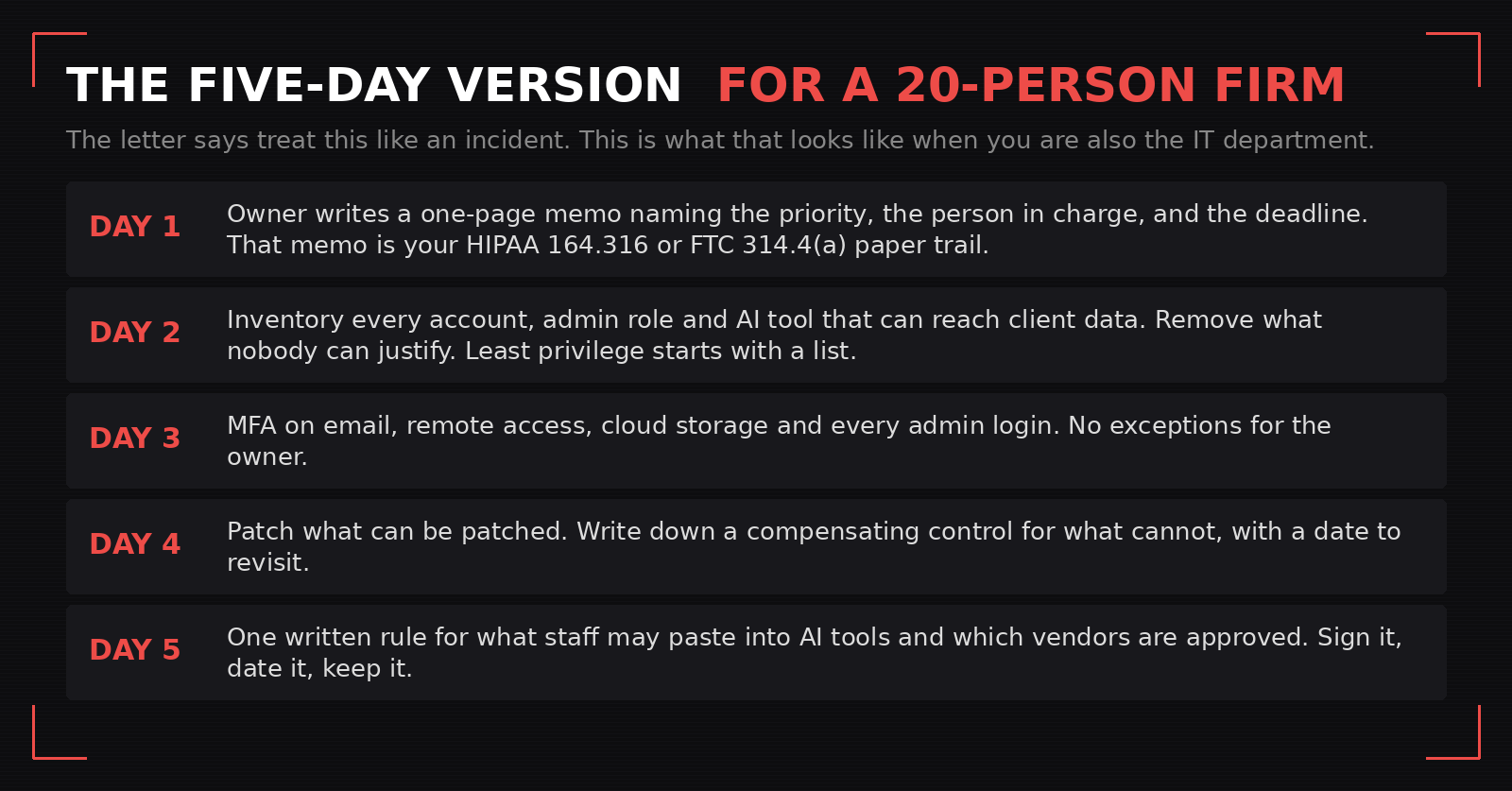
Day 1. Write the memo. One page, signed by the owner or managing partner, naming the priority, the person responsible and the date by which the rest of this list is done. Under HIPAA that document satisfies 164.308(a)(2) and starts the 164.316 documentation trail. Under the Safeguards Rule it is the record that a Qualified Individual was designated. Under 800-171 it is the first page of your SSP. If OCR, the FTC or a DIBCAC reviewer ever asks what leadership did after the August 2026 warnings, this is the answer.
Day 2. Inventory access. Every user account, every admin role, every third-party integration and every AI tool that can reach client data. Remove what nobody can justify in a sentence. This is the letter’s “excessive permissions” item and the single control that would have contained most of the incidents in Shadow AI Breach Cost 2026, where IBM found shadow AI present in 43 percent of breaches at an average cost of $5.39 million. A firm that finds that number abstract should ask which of its staff have signed up for an AI note-taker with calendar and email access, then re-read AI Meeting Assistant Security Risks.
Day 3. MFA everywhere. Email, remote access, cloud file storage, the practice management or accounting platform, and every admin login. No exception for the owner, because the owner’s mailbox is the one an attacker wants. The Safeguards Rule requires this outright. HIPAA requires authentication at 164.312(d) and does not name MFA in the current rule; the proposed Security Rule update would, and OCR settlements already treat single-factor remote access as a risk management failure. NIST 800-171 3.5.3 requires it for privileged accounts and for all network access.
Day 4. Patch or compensate. Patch what can be patched. For the system that cannot be, the imaging workstation on an old OS, the CNC controller, the legacy line-of-business app, write down the compensating control (network segmentation, no internet access, restricted logins) and the date you will revisit it. The letter says this in almost exactly those words, and so does 800-171 3.12.2 for defense contractors. For a HIPAA covered entity this is the risk management documentation OCR asks for first.
Day 5. One written AI rule. What staff may paste into AI tools, which tools are approved, what happens to client data inside them, and who signs off on anything built or deployed with AI-generated code. Sign it, date it, keep it with the memo from Day 1. That is the whole of the letter’s “buy, build, deploy” instruction at small-firm scale.
For a healthcare practice, the HIPAA Security Risk Assessment Tool: Excel + Guide ($57) produces the Day 2 and Day 4 documentation in the form OCR expects. For any regulated firm, the AI Acceptable Use Policy Kit ($47) is the Day 5 document. Defense contractors already tracking these controls against 800-171 will recognize the five days as items already on their POA&M; the letter just moved the date up.
The bottom line
One hundred fifty-five organizations, including the companies that build the models, sell the defenses and underwrite the losses, signed a statement on August 27 that AI-enabled attacks get materially worse within months. The letter does not mention small business and creates no legal obligation for one. It does not need to. Every instruction in its “every organization” paragraph already has a rule number under HIPAA, the FTC Safeguards Rule or NIST 800-171, and the only thing the letter adds is a timeframe. Five working days covers it for a 20-person firm. The memo you write on Day 1 is the document that proves you read the warning.
Sources
- OpenAI, “A call for collective action on cyber defense,” open letter and signatory list, published August 27, 2026, signatory count checked August 31, 2026 (openai.com/collective-cyberdefense)
- UK National Cyber Security Centre, with CISA, NSA, ASD, Canadian Centre for Cyber Security and NZ GCSB, “The AI shift in cyber risk: why leaders must act now,” joint statement, June 22, 2026
- NSA, CISA, FBI, DOE and EPA, joint advisory on AI-enabled exploitation of internet-exposed Siemens S7 PLCs, August 19, 2026
- Hugging Face, security incident disclosure, July 16, 2026; “Anatomy of a Frontier Lab Agent Intrusion,” July 27, 2026
- Rep. Greg Casar, oversight letter to OpenAI CEO Sam Altman, August 10, 2026, and press release “Casar Leads Demand for Information From Open AI About Security Incident” (casar.house.gov)
- H.R. 9917, AI Kill Switch Act, 119th Congress, introduced July 23, 2026, referred to the House Committee on Homeland Security (congress.gov); Rep. Ted Lieu press release, July 23, 2026
- Politico, “House AI ‘kill switch’ bill unveiled as OpenAI hack raises alarms,” July 23, 2026 (revenue and compute thresholds)
- Business Insider, “OpenAI Told by 15 Attorneys General to Preserve Hugging Face Evidence,” August 3, 2026
- BBC News, “AI firms must answer for rogue bots, says Hugging Face boss,” July 31, 2026
- 45 CFR Part 164, Subpart C, HIPAA Security Rule (eCFR)
- 16 CFR Part 314, Standards for Safeguarding Customer Information (FTC Safeguards Rule) (eCFR)
- NIST SP 800-171 Rev 2, Protecting Controlled Unclassified Information in Nonfederal Systems and Organizations
- IBM, Cost of a Data Breach Report 2026 (shadow AI prevalence and cost figures)