Shadow AI Breach Cost 2026: The Number Doubled and the Controls Went Backwards
Employees adopted AI faster this year. Companies approved it less. IBM just published the bill for the gap between those two lines.
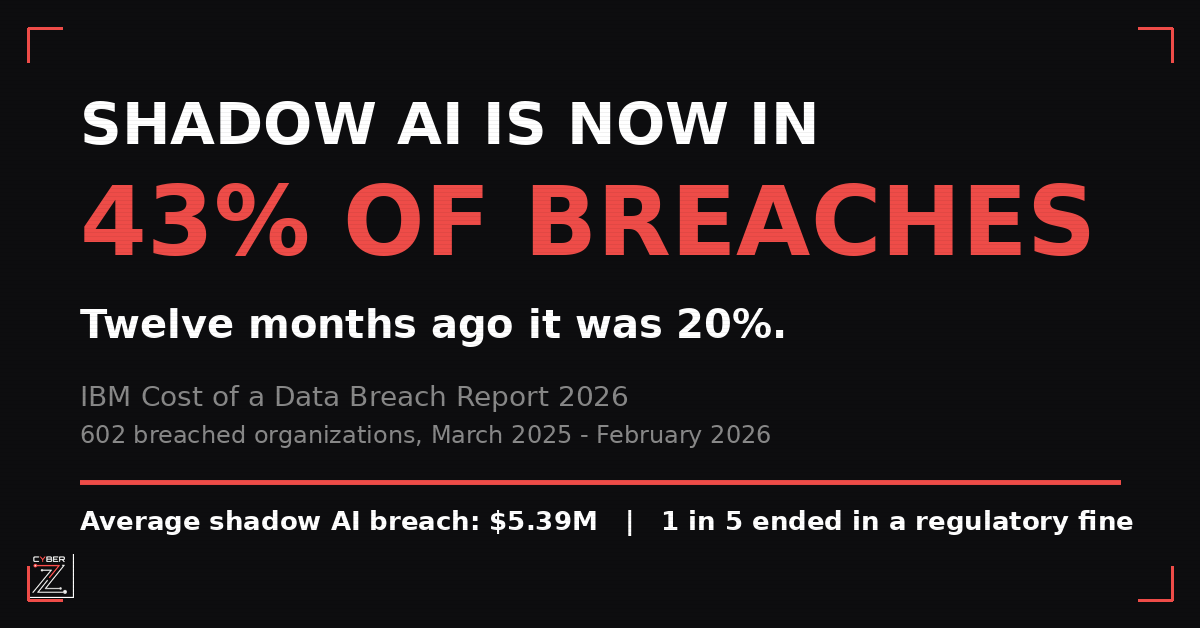
Shadow AI breach cost is the measurable financial damage attributable to security incidents involving AI tools that employees use without their organization’s approval or oversight. In IBM’s 2026 Cost of a Data Breach Report, conducted by Ponemon Institute across 602 breached organizations, that damage now has a specific price: breaches involving shadow AI averaged $5.39 million, against a global average of $4.99 million, and roughly one in five of them also ended in a regulatory fine. The share of breached organizations reporting shadow AI incidents more than doubled in a single year, from 20% to 43%.
- IBM's 2026 Cost of a Data Breach Report (published July 29, 2026, research by Ponemon Institute, 602 organizations breached between March 2025 and February 2026 across 17 industries and 16 countries) found shadow AI involved in 43% of breaches, up from 20% the year before.
- A breach involving shadow AI averaged $5.39 million. The global average for any breach was $4.99 million, itself up 12% year over year. About one in five shadow AI breaches also resulted in a regulatory fine.
- Governance moved in the opposite direction. 68% of breached organizations had no AI governance in place, up from 63%. The share requiring IT approval before deploying AI fell from 45% to 38%. Only 19% said their governance and security teams coordinate.
- The attack side is scaling too: one in four malicious breaches was AI-enabled, a 56% increase over last year, at an average cost of $6 million, driven mostly by deepfake impersonation and AI-enabled malware.
- Where AI systems themselves were breached, the top causes were unglamorous: compromised APIs, applications or plug-ins (27%) and cloud misconfigurations affecting AI workloads (27%).
- For a small firm the response is administrative before it is technical: inventory what your team already uses, write the acceptable use policy, name an approval path, and put the AI vendors through the same due diligence as any other vendor holding your data.
What the 2026 report actually measured
The Cost of a Data Breach Report is the closest thing breach economics has to a canonical dataset. Ponemon Institute interviews organizations that experienced a real breach, then IBM sponsors and analyzes the results. The 2026 edition covers 602 organizations breached between March 2025 and February 2026, across 17 industries and 16 countries.
Three numbers from this year’s edition matter to a firm with 20 to 50 employees.
First, the global average breach cost reached $4.99 million, a 12% increase over last year. That average includes large enterprises, so your number would be smaller, but the direction and the growth rate apply at every size.
Second, shadow AI went from a side finding to a primary breach factor. In last year’s edition, 20% of breached organizations reported that unapproved AI tools were involved. This year it is 43%. Those breaches cost more than the average, $5.39 million, and about one in five of them brought a regulatory fine along with the incident costs.
Third, and this is the part most coverage skipped, the control environment got weaker while the exposure grew.
The scissors: usage up, approval down
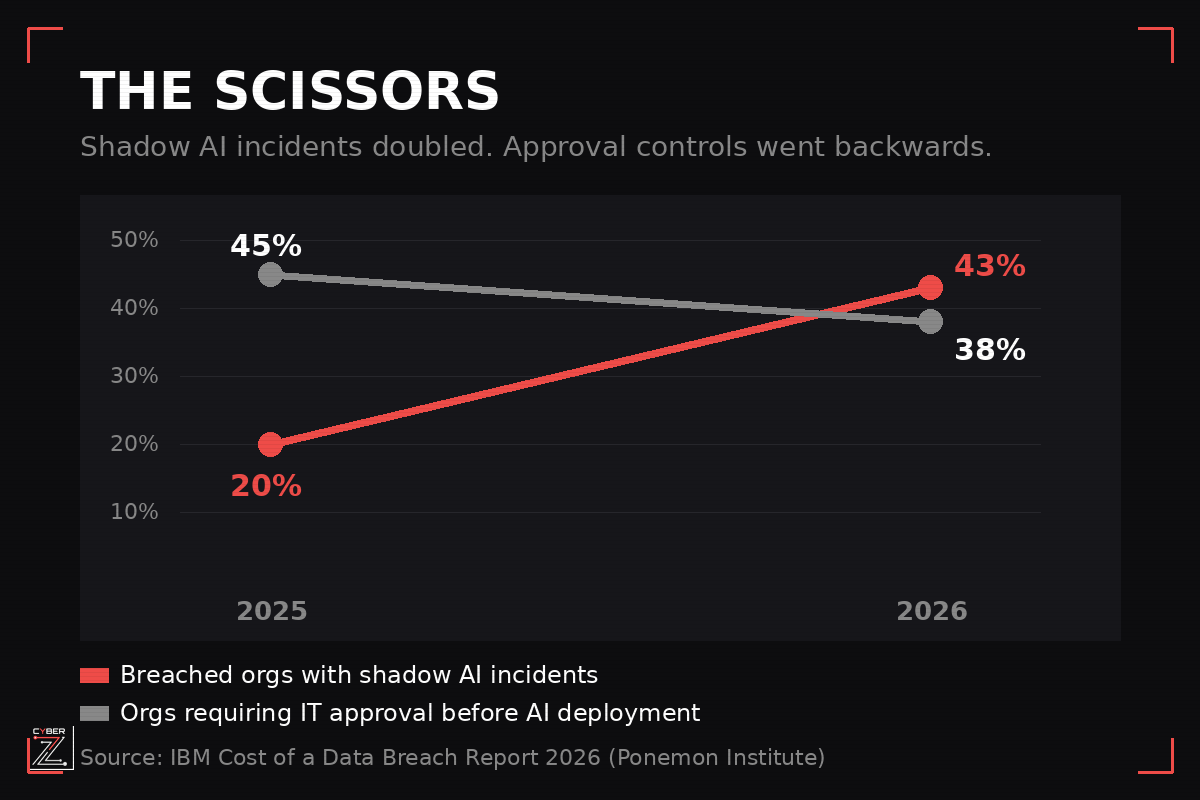
Put the two trend lines on the same chart and they cross like scissors.
Shadow AI incidents: 20% to 43%. Organizations requiring IT approval before AI is deployed: 45% down to 38%. Organizations with no AI governance at all: 63% up to 68%. And in a question Ponemon asked for the first time this year, only 19% of organizations said their governance and security teams coordinate their AI efforts.
Read plainly: as employees adopted AI tools at the fastest rate in the study’s history, the average company loosened its grip rather than tightening it. Not because anyone decided shadow AI was fine. More likely because approval processes built for traditional software procurement collapsed under the volume of AI tools arriving through browser tabs, app marketplaces, and features switched on inside software the company already owns.
That last route matters. A meeting note-taker that appears inside your video platform, an AI assistant bundled into your accounting software, a summarization feature in your email client. None of those pass through a purchasing decision, so a policy that says “all software purchases require approval” never fires. We walked through that failure mode in our breakdown of shadow AI risks for small businesses, and the 2026 numbers confirm it is the dominant pattern, not the exception.
Why the shadow AI breaches cost more
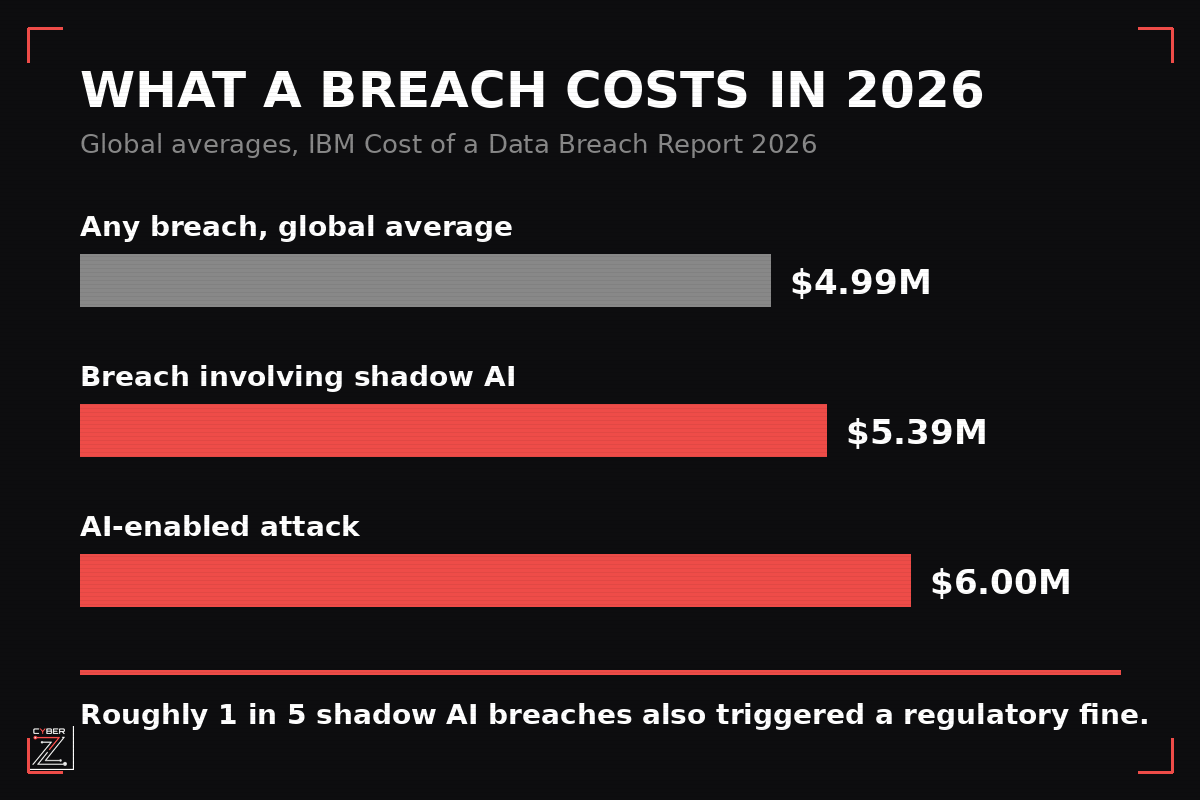
The $400,000 premium on a shadow AI breach is not mysterious. Three mechanisms drive it.
Nobody can scope the incident. When a sanctioned system is breached, the security team knows what data lives there. When the breach involves a tool nobody approved, the first week of incident response is spent discovering what the tool was, who used it, and what they pasted into it. Discovery time is the single most reliable driver of breach cost in every edition of this report.
The data is often the sensitive kind. People reach for unapproved AI tools to handle the tedious work: summarizing client files, drafting responses to patients, cleaning up contract language. That is exactly the material with regulatory strings attached. Which is why roughly one in five shadow AI breaches ended with a fine on top of the incident costs.
There is no contract to fall back on. A sanctioned vendor signed a data processing agreement, a business associate agreement, or DFARS flow-down terms. A tool an employee signed up for with a personal email signed nothing. Whatever the vendor’s consumer terms say about retention and model training is what you get.
For a healthcare practice, an unapproved tool processing patient information is a disclosure of PHI to a party with no business associate agreement, the same exposure pattern regardless of whether a breach ever occurs. For a defense subcontractor, an unapproved AI tool touching CUI is an unauthorized cloud service under DFARS 252.204-7012, which requires FedRAMP Moderate or equivalent for covered defense information. The breach just converts a latent compliance failure into a billable event.
The attacker side of the same report
The same report puts numbers on the offensive use of AI, and they rhyme. One in four malicious breaches was AI-enabled, a 56% increase over last year, at an average cost of $6 million, roughly $1 million above the global average. IBM attributes most of these to deepfake impersonation and AI-enabled malware.
And where AI systems themselves were the target (more than 20% of organizations reported a breach of an AI model or application), the causes were not exotic prompt wizardry. They were compromised APIs, applications or plug-ins (27%) and cloud misconfigurations affecting AI workloads (27%). The same two failure classes that have led every breach report for a decade, now with an AI system on the receiving end.
One more number cuts the other way: organizations using AI and automation in their own security operations reduced breach costs by an average of nearly $2 million. The technology is not the problem. Ungoverned adoption is.
What a 20 to 50 person firm does with this
You do not need an AI governance committee. You need four things, and the first three fit in one working session.
1. Inventory what is already in use. Ask, in writing, without threat of punishment: which AI tools do you currently use for work, including features inside tools we already own? Amnesty gets you an honest list. The list is the scope for everything else.
2. Write the acceptable use policy. One or two pages. Which categories of data may never go into an AI tool (patient information, client files, CUI, payroll). Which tools are approved today. What an employee does when they want a new one. The 68% of breached organizations with no governance did not lack technology. They lacked this document. We covered the structure in our guide to writing an AI acceptable use policy for a small business.
3. Name the approval path. The 45%-to-38% decline happened because approval was slower than adoption. Make it fast on purpose: one named person, one request form, an answer within a week. A fast yes-or-no beats a thorough process nobody uses.
4. Vet the vendors that make the approved list. Retention terms, training-on-your-data defaults, subprocessors, breach notification commitments, and whether the vendor will sign the agreement your regulator expects (BAA, DPA, or DFARS flow-down). The checklist is in our AI vendor due diligence walkthrough.
If you want the policy, the employee request form, and the approval workflow as editable templates rather than a blank page, the AI Acceptable Use Policy Kit ($47) is the version of this we ship.
The bottom line
IBM’s 2026 numbers describe a gap that widened from both sides at once: shadow AI incidents doubled to 43% of breaches while the share of companies requiring approval before AI deployment fell to 38%. The breaches on the wrong side of that gap cost $5.39 million on average and drew a regulatory fine one time in five. Closing your own gap is mostly paperwork: an inventory, a two-page policy, a named approver, and vendor checks. The firms that do the paperwork this quarter will not show up in next year’s 43%.
Sources
- IBM Newsroom, “IBM Study: One in Four Malicious Breaches are AI-Enabled, Costing Companies $6 Million on Average,” July 29, 2026. https://newsroom.ibm.com/2026-07-29-ibm-study-one-in-four-malicious-breaches-are-ai-enabled,-costing-companies-6-million-on-average
- IBM, Cost of a Data Breach Report 2026 (research by Ponemon Institute). https://www.ibm.com/reports/data-breach
- DFARS 252.204-7012, Safeguarding Covered Defense Information and Cyber Incident Reporting.
- 45 CFR 164.502(e), HIPAA Privacy Rule, disclosures to business associates.