AI Agent Security Risks: What Small Firms Must Check Before Agents Touch Client Data
Your team is connecting AI agents to email, files, calendars, and client records. In most firms, nobody approved it, nobody scoped what those agents can reach, and nobody is reviewing what they do. This is what to check before an agent touches client data.
AI agents are software systems that act autonomously: they read your email, open your files, call other tools, and complete multi-step tasks with limited human supervision. The security risk is structural: an agent inherits every permission of the account that runs it, follows instructions found in the content it reads, and operates at machine speed. For a small firm, one over-permissioned agent is functionally an insider with keys to everything.
- An AI agent is not a chatbot. A chatbot answers; an agent acts: it sends, deletes, books, pays, and posts using your credentials.
- Gartner projects 40% of enterprise applications will include task-specific AI agents by the end of 2026, up from under 5% in 2025. Small firms adopt through the same SaaS tools.
- Cisco's State of AI Security 2026 found only 29% of organizations were prepared to secure agentic AI deployments. A Gravitee survey of 900+ executives found just 14.4% of agents go live with full security or IT approval.
- Prompt injection needs no malware. Hidden instructions in a document, email, or web page can redirect an agent that reads them.
- NIST launched an AI Agent Standards Initiative in February 2026. Formal guidance is coming; your clients' data is exposed now.
- The fix for a small firm is not a security team. It is scoped access, an approval step, an activity log, and a written AI acceptable use policy.
Agents arrived in small firms the same way ChatGPT did: through individual employees, not through an IT decision. Someone connected an assistant to the shared inbox to triage messages. Someone else pointed a scheduling agent at the firm calendar. A paralegal wired a research agent into the document folder. Each choice was reasonable on its own. Nobody looked at the sum.
This piece continues the ground covered in our shadow AI guide, and the difference matters. Shadow AI was employees pasting data into tools. Agents are tools reaching into your data, and then acting on it.
Why an Agent Is a Different Risk Class Than a Chatbot
A chatbot’s worst case is bad output: a wrong answer, a leaked prompt. An agent’s worst case is a bad action taken with your authority. Agents in current business tools can send email from your address, modify and delete files, create calendar invites, update CRM records, and trigger payments or workflows in connected apps.
Three properties make this a new risk class for a firm of 10 to 50 people:
| Property | What it means in practice |
|---|---|
| Autonomy | The agent completes multi-step tasks without a human confirming each step. Errors compound before anyone looks. |
| Inherited permissions | The agent runs as the user who connected it. If you can see every client folder, so can it. |
| Instruction-following | The agent treats text it reads as potential instructions. That includes text an attacker planted. |
The third one deserves its own section, because it is the mechanism most business owners have never heard of.
Prompt Injection, in Plain English
An agent cannot reliably tell the difference between content it should summarize and commands it should follow. Attackers exploit that by hiding instructions inside things your agent will read: an inbound email, a shared document, a web page, a calendar invite, even a support ticket.
The agent reads the planted text, interprets it as a legitimate task, and acts using your real credentials through your real access. No malware, no breached password. Just text, read by software you authorized.
This is not theoretical. Cisco’s State of AI Security 2026 documents a case in which a malicious issue filed against a GitHub Model Context Protocol server injected hidden instructions that hijacked an agent and triggered data exfiltration from private repositories. The same mechanism works against any agent that reads untrusted content, which is every agent connected to email.
The US government considers this serious enough that NIST’s Center for AI Standards and Innovation issued a Request for Information on securing AI agent systems in January 2026, naming indirect prompt injection as a distinct risk, and launched the AI Agent Standards Initiative the following month. NIST’s National Cybersecurity Center of Excellence is separately building guidance on agent identity and authorization. Translation for a small firm: the standards bodies are treating agents as a new category of actor on your network. You should too.
The Adoption Gap Is the Actual Problem
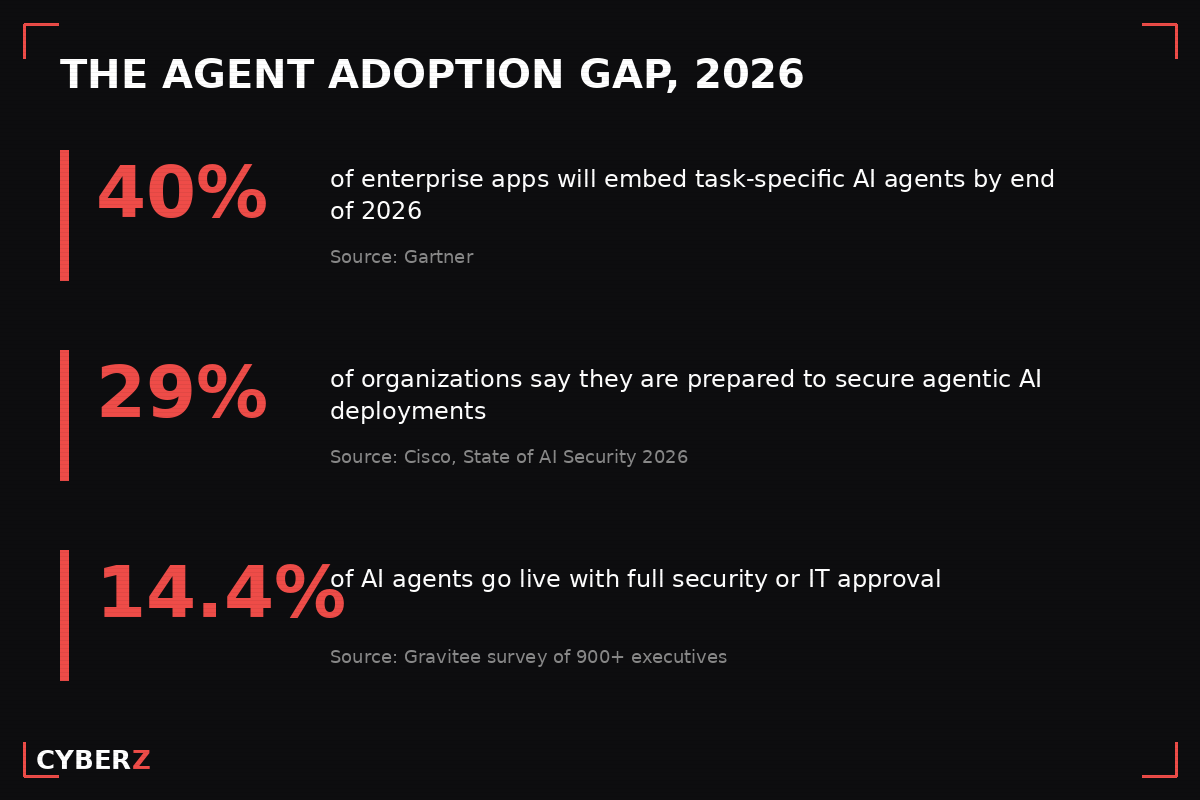
The numbers describe a gap between how fast agents are arriving and how slowly anyone is securing them:
- Gartner projects that 40% of enterprise applications will include task-specific AI agents by the end of 2026, up from less than 5% in 2025. Those applications are the same Microsoft, Google, and SaaS tools small firms run on.
- Cisco’s State of AI Security 2026 found that while most organizations planned to deploy agentic AI, only 29% reported being prepared to secure those deployments.
- A Gravitee survey of more than 900 executives and technical practitioners found 80.9% of technical teams have agents in testing or production, but only 14.4% say those agents go live with full security or IT approval.
Enterprises at least have security teams to eventually catch up. A 15-person practice has an office manager and an MSP invoice. The gap lands harder on you.
The Permission Problem
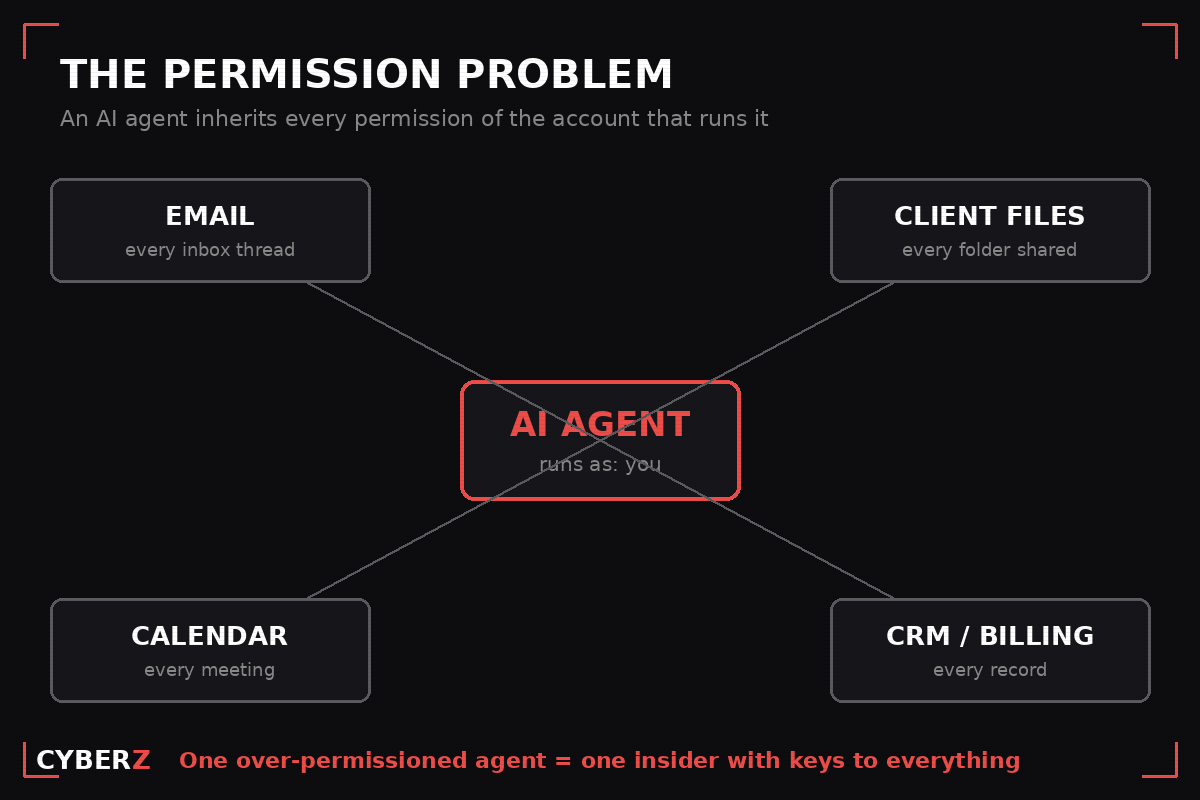
When an employee connects an agent to their account, the agent typically receives the employee’s access, not a scoped subset. Most small firms already over-permission their people; every prior year of “just give everyone access to the shared drive” is now inherited by software that reads everything, remembers nothing about your intent, and follows instructions found in the wild.
Ask these three questions about every agent in your firm. If nobody can answer them, that is the finding.
- What can it access? Which mailboxes, folders, calendars, and systems can this agent actually reach, versus what it needs for its task?
- What can it do? Read-only is one risk tier. Send, modify, delete, and pay are another. Does anything require a human click before the agent commits an action?
- Who reviews what it did? Is there a log of agent actions someone actually checks? If an agent sent 40 emails last Tuesday, would anyone know?
Are AI Agents Safe for Business?
Safe the way a new hire is safe: it depends entirely on what you give them access to and whether anyone supervises. Agents deployed with scoped permissions, human approval on consequential actions, and logged activity are a manageable risk with real productivity gains. Agents connected by whoever got there first, with full user permissions and no review, are the least supervised actor in your firm with the broadest access.
For regulated verticals the stakes are contractual, not just operational. A clinic’s agent reading patient records is a HIPAA question under the Security Rule’s access controls (45 CFR 164.312). A law firm’s agent touching client files is a confidentiality question under ABA Model Rule 1.6 and its duty of technology competence. A CPA firm’s agent in the client portal sits inside the written information security plan the FTC Safeguards Rule and IRS Pub 4557 already require. The agent does not create these obligations. It creates a new, fast, unsupervised way to breach them.
AI Policy for Small Business: The Layer That Fixes This
You cannot secure what has no rules. The reason 85.6% of agents go live without approval is not malice; it is that most firms never defined what approval means. A written AI policy is how a firm without a security team gets control of this: it turns “whatever anyone connects” into “what we decided, on record.”
For a small firm the policy does four jobs: it defines which AI tools and agents are approved, sets what data classes they may touch, requires an approval step before anything connects to firm systems, and names who reviews agent activity. One page that does those four jobs beats a 20-page policy nobody reads.
What Belongs in an AI Acceptable Use Policy
If you draft one this week, cover these elements:
- Approved tools list. Named tools and agents, with everything else prohibited by default until reviewed.
- Data classification rules. Which categories (client PII, PHI, financial records, privileged material) may never be given to an AI tool or reachable by an agent.
- Agent permission standard. Agents get task-scoped access, not full user permissions. Consequential actions (send, delete, pay, file) require human confirmation.
- Approval workflow. Who signs off before a tool or agent connects to firm email, storage, or client systems.
- Logging and review. Agent activity is logged; a named person reviews it on a schedule.
- Incident steps. What staff do the moment an AI tool does something unexpected, and who they tell.
- Employee acknowledgment. Signed, dated, kept on file. This is also what an insurer or regulator asks for first.
Our AI Acceptable Use Policy Template for Business: 2026 ($47) is that document, pre-built with the clauses above and ready to adapt to your firm.
What to Do This Week
- Inventory. Ask every staff member which AI tools and agents they use and what those tools are connected to. Expect surprises; that is the point. The Shadow AI Risk Assessment for Business: Discovery Kit ($47) gives you the structured version of this exercise.
- Cut permissions. For every agent found, reduce access to what the task requires. Disconnect anything nobody claims.
- Add an approval gate. From today, no tool or agent connects to firm systems without a named person signing off.
- Turn on logging. Most business AI platforms have activity logs. Enable them and put a monthly review on someone’s calendar.
- Put the policy in writing. Adopt an acceptable use policy, have staff sign it, and file the acknowledgments.
If you are standing up the whole rules layer at once (policy, governance framework, vendor vetting, employee training) because a client, insurer, or regulator is already asking, the AI Governance & Policy Starter Kit: 5-Guide Bundle ($147) packages the five documents that conversation requires.
The Bottom Line
AI agents are not a future risk. They are present in your firm now, connected by default to more than they need, approved by almost no one, and instructable by anyone who can get text in front of them. The response does not require a security department. Scope the access, gate the connection, log the activity, and write the rules down. Firms that do those four things get the productivity without donating their client data to whoever asks their agent nicely.
Sources
- Gartner, projection on task-specific AI agents in enterprise applications, 2025-2026
- Cisco, State of AI Security 2026
- Gravitee, 2026 Agentic AI survey of 900+ executives and technical practitioners
- NIST CAISI, Request for Information on Securing AI Agent Systems, January 2026
- NIST, AI Agent Standards Initiative announcement, February 2026
- NIST NCCoE, Accelerating the Adoption of Software and AI Agent Identity and Authorization, concept paper, February 2026
- HHS, HIPAA Security Rule, 45 CFR 164.312
- ABA Model Rules of Professional Conduct, Rule 1.6
- FTC Safeguards Rule; IRS Publication 4557