Is ChatGPT HIPAA Compliant? What Changed in January 2026, and What Your Practice Does Now
Somewhere in your practice today, someone summarized a patient email with ChatGPT, drafted a referral letter with it, or asked it to explain a lab result in plain English. They did it on a personal account, it took forty seconds, and it worked. That is exactly the problem.
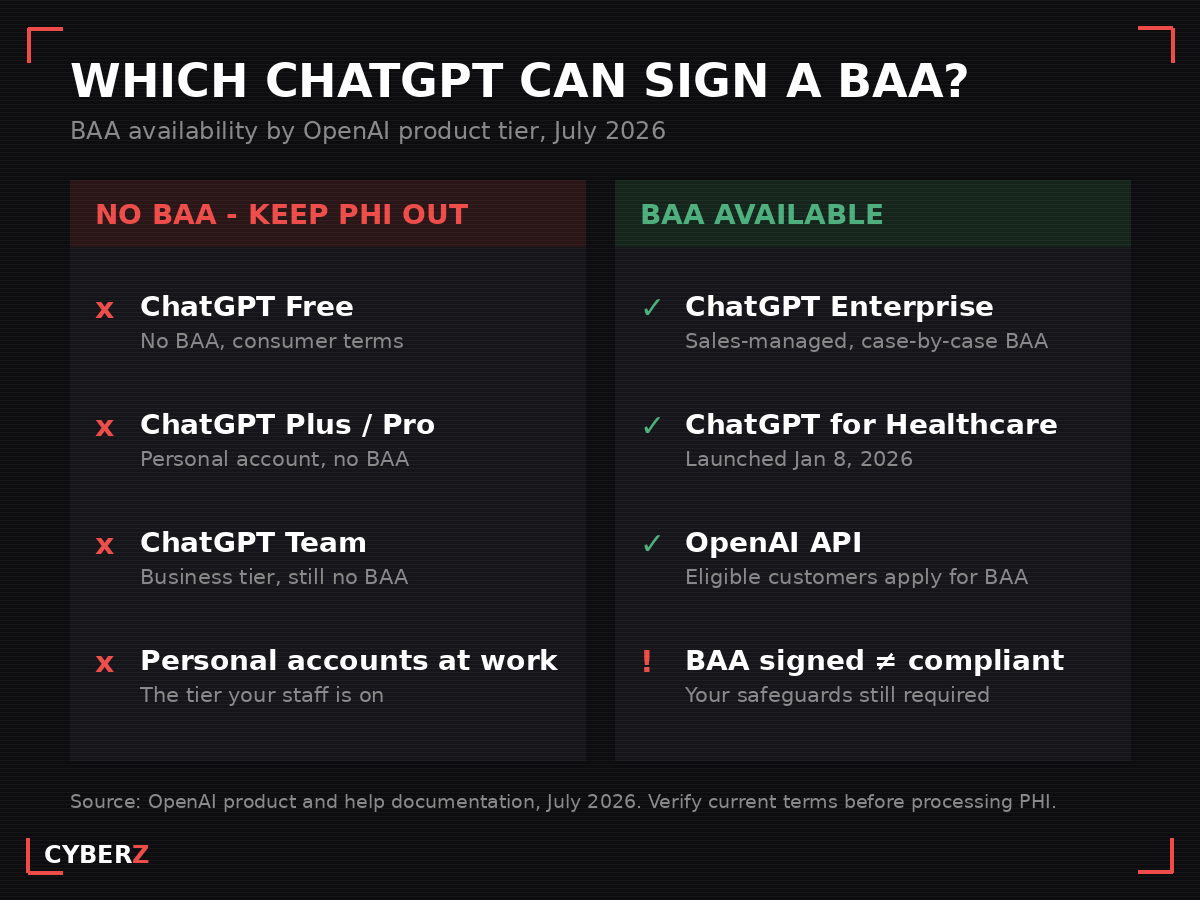
No, ChatGPT is not HIPAA compliant in the versions almost everyone actually uses. OpenAI does not sign a Business Associate Agreement (BAA) for ChatGPT Free, Plus, Pro, or Team, which means no protected health information (PHI) may lawfully touch those tiers. Since January 2026, OpenAI does offer BAA-eligible products: ChatGPT Enterprise (sales-managed), the new ChatGPT for Healthcare, and the OpenAI API for eligible customers. A signed BAA makes compliant use possible. It does not make it automatic.
- Consumer ChatGPT tiers (Free, Plus, Pro, Team) are not BAA-eligible. PHI entered there has no HIPAA protection, and no enterprise contract elsewhere in your organization fixes that.
- OpenAI launched OpenAI for Healthcare on January 8, 2026, with BAA support for ChatGPT Enterprise, ChatGPT for Healthcare, and eligible API customers. The compliance answer changed; the answer for personal accounts did not.
- A BAA is necessary but not sufficient. Access controls, audit logging, training, and your risk analysis determine whether use is actually compliant.
- OCR's Risk Analysis Initiative reached its 14th enforcement action in June 2026. If staff AI use is not in your risk analysis, the analysis is incomplete under 45 CFR § 164.308(a)(1)(ii)(A).
- The HIPAA Security Rule overhaul slipped to a 2027 target. Enforcement of the current rule did not slip with it.
The question changed in January 2026
For years the answer was a flat no. The HIPAA Journal’s guidance, updated January 13, 2026, still opens with the operative fact: generic ChatGPT services are not HIPAA compliant and cannot be used in a HIPAA-compliant manner.
Then on January 8, 2026, OpenAI launched OpenAI for Healthcare: a healthcare-specific enterprise workspace (ChatGPT for Healthcare) plus API support aimed at clinical and administrative use, with BAA availability, audit logs, data residency options, and a commitment that content shared with ChatGPT for Healthcare is not used to train models. Boston Children’s Hospital appeared in the launch materials. Abridge, Ambience, and EliseAI were named as companies building on the API.
So the honest 2026 answer has two halves. There is now a ChatGPT that can sit inside a HIPAA compliance program. And it is almost certainly not the ChatGPT your front desk is using.
Why the consumer tiers can never carry PHI
HIPAA’s rule here is mechanical. Under 45 CFR § 164.502(e) and § 164.308(b), a covered entity may only let a vendor create, receive, maintain, or transmit PHI on its behalf if that vendor has signed a BAA accepting HIPAA obligations directly. No BAA, no PHI. There is no small-use exception, no “we only pasted a paragraph” exception, and no de minimis carve-out.
OpenAI’s own Services Agreement states, in capital letters, that not all OpenAI services are designed for processing protected health information. BAAs are available only for the API platform, ChatGPT Enterprise for sales-managed customers, and ChatGPT for Healthcare. Free, Plus, Pro, and Team are excluded.
Two details practices routinely get wrong:
- “Team” sounds official but is not BAA-eligible. Buying the Team tier for the office does not change the PHI answer.
- A BAA elsewhere does not cover personal accounts. If your EHR vendor’s AI feature runs under a BAA, that agreement covers that pipeline. It does nothing for the medical assistant using her own ChatGPT app at lunch.
De-identified data is the one legitimate path onto non-BAA tools, but only if it actually meets HIPAA’s de-identification standard under 45 CFR § 164.514(b): Safe Harbor’s full 18-identifier removal or a formal Expert Determination. Deleting the patient’s name from a paragraph that still contains a rare diagnosis, a date of service, and a town of 900 people does not qualify.
“But we’d never approve that” is not a defense
Here is the uncomfortable part. This is not a question about what your practice approves. It is a question about what your staff already does.
WatchGuard’s 2026 Cybersecurity Hygiene Report, released July 14, surveyed 684 employees at small and mid-sized organizations and found that 64% admit to using AI tools their employer never authorized. That is not an enterprise problem trickling down; the survey population is firms your size. The pattern shows up in healthcare specifically because the workloads AI handles well, such as summarizing, drafting, and translating jargon, are precisely the tasks a busy clinic drowns in.
When OCR investigates after a breach report or complaint, the question is not whether you had a policy PDF somewhere. Investigators ask where ePHI lives and moves, and whether your security risk analysis accounted for it. An AI tool your staff uses weekly that appears nowhere in your risk analysis is a finding waiting to be written. We covered what a compliant analysis has to include in HIPAA Risk Analysis Requirements in 2026: The Scope Gaps OCR Is Fining, and unsanctioned AI is now one of the most common scope gaps.
The enforcement backdrop: risk analysis, again and again
OCR launched its Risk Analysis Initiative in October 2024 with a $90,000 settlement against a county ambulance service, and the program has become the agency’s most reliable enforcement engine. On April 23, 2026, OCR announced four ransomware-related settlements in a single day, totaling $1,165,000 and covering roughly 427,000 patients, with the same root finding in each: no accurate and thorough risk analysis under 45 CFR § 164.308(a)(1)(ii)(A). By June 18, 2026, with a $450,000 settlement against an employer health plan, the initiative had reached fourteen enforcement actions.
The legal theory matters for the AI question. OCR is not penalizing entities for being attacked. It penalizes them for never having mapped where their ePHI lives and what threatens it. Staff pasting patient information into consumer chatbots is, from that lens, ePHI moving to an unmapped location with no BAA, no audit trail, and no retention control. The sizes of the settling entities should also register: single-location clinics and small vendors, not just health systems, as we detailed in HIPAA Fines for Small Practices: What OCR Enforcement Actually Looks Like in 2026.
One more piece of context. The proposed Security Rule overhaul that would make encryption and MFA mandatory has slipped: OMB’s Unified Agenda now targets July 2027 for final action, after the spring 2026 window passed with OCR still reviewing roughly 4,700 comments. Some practices read that as breathing room. It is the opposite. The rule being enforced against small entities right now is the current one, and the most-cited failure under it is the risk analysis you can fix this quarter.
What a practice actually does about it
Not a transformation program. Four steps, most of them doable inside a month.
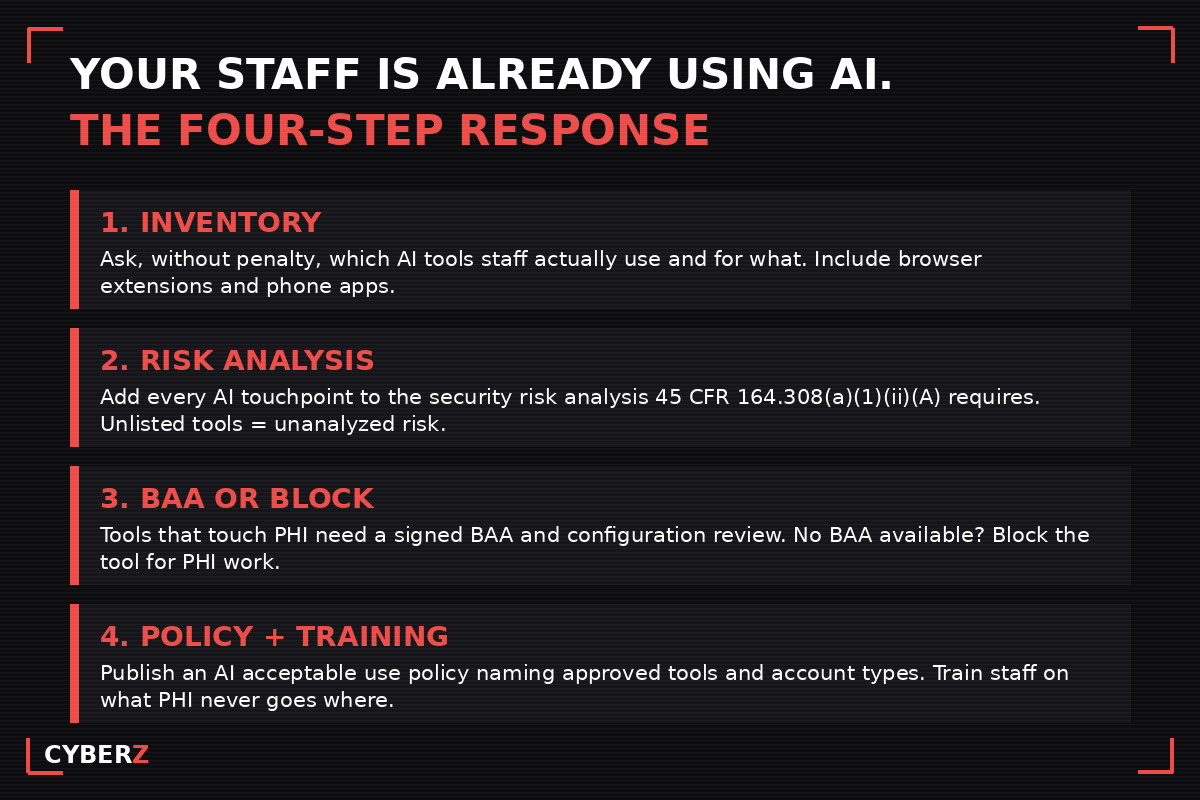
1. Inventory real AI use, without punishment. Ask every role which AI tools they actually use and for what, and make it explicitly amnesty-based, because a survey staff are afraid to answer honestly produces a fictional inventory. Include browser extensions, phone apps, and AI features inside software you already own.
2. Put every AI touchpoint into the risk analysis. Each tool gets the same treatment as any system: what data could reach it, on what accounts, with what vendor terms, at what likelihood and impact. This is the step that converts “we sort of know people use ChatGPT” into a documented, defensible position.
3. BAA or block, per tool. Anything that touches PHI needs a signed BAA plus configuration review (a BAA on a misconfigured deployment is paperwork, not compliance). Where no BAA is available, which includes every consumer ChatGPT tier, the tool is blocked for PHI work, and staff get a sanctioned alternative so the ban survives contact with a busy Tuesday.
4. Publish the policy and train to it. A short AI acceptable use policy naming approved tools, approved account types, and prohibited data categories, then fifteen minutes of training on what PHI never goes where. We walked through the full structure in AI Acceptable Use Policy: What a Small Business Actually Needs in 2026.
If step two is the one you have been putting off, that is the gap the HIPAA Security Risk Assessment Tool: Excel + Guide ($57) was built to close: a structured Excel workbook that walks a small practice through the analysis OCR keeps citing, with the AI and SaaS tools your staff actually uses in scope from the start. For step four, the AI Acceptable Use Policy Kit ($47) is the ready-to-adapt policy.
FAQ
Is using ChatGPT a violation of HIPAA? Using ChatGPT is not itself a violation. Entering PHI into a ChatGPT tier with no BAA is an impermissible disclosure. The tool is lawful; the data flow is the problem.
Are doctors allowed to use ChatGPT? Yes, for tasks involving no PHI: literature summaries, drafting generic patient education material, administrative writing. For anything touching identifiable patient information, only BAA-covered deployments qualify, with your organization’s controls on top.
Can ChatGPT be HIPAA compliant? ChatGPT Enterprise, ChatGPT for Healthcare, and the OpenAI API can support HIPAA-compliant use under a signed BAA with proper configuration. Consumer ChatGPT cannot, regardless of settings.
Is ChatGPT safe for confidential information generally? Consumer tiers may use conversations for model improvement depending on settings, and retention is outside your control. For regulated data of any kind, treat non-enterprise AI tools as public.
Does the Security Rule delay change any of this? No. The 2027 delay applies to the proposed overhaul. The BAA requirement and the risk analysis requirement are current law and are actively enforced.
Sources
- OpenAI, “Introducing OpenAI for Healthcare” (January 8, 2026): openai.com
- OpenAI Help Center, “ChatGPT for Healthcare”: help.openai.com
- The HIPAA Journal, “Is ChatGPT HIPAA Compliant? Updated for 2026” (January 13, 2026): hipaajournal.com
- WatchGuard Technologies, 2026 Cybersecurity Hygiene Report (July 14, 2026): globenewswire.com
- HHS OCR, Guidance on Risk Analysis; 45 CFR § 164.308(a)(1)(ii)(A): hhs.gov
- HHS OCR ransomware settlements announcement, April 23, 2026 (four settlements, $1,165,000): nixonpeabody.com summary
- Nixon Peabody, 14th Risk Analysis Initiative action, Spencer Gifts plan settlement (June 18, 2026): nixonpeabody.com
- The HIPAA Journal, “HIPAA Security Rule Update Postponed” (July 2026, OMB RIN 0945-AA22): hipaajournal.com
- 45 CFR § 164.502(e), § 164.308(b), § 164.514(b): ecfr.gov