CMMC Phase 2 Explained: What November 10, 2026 Actually Means for a Small Defense Contractor
If you run a small shop with DoD work, you have probably seen the same headline a dozen times this year: November 10, 2026 is the CMMC deadline, the clock is ticking, get certified or lose your contracts. The date is real. The framing around it is mostly wrong, and the wrong framing is what gets small subcontractors into trouble.
This is a plain-English walkthrough of what changes on that date, who it actually applies to, and what a 15-to-50-person contractor should be doing about it right now. No jargon without a definition, no manufactured panic.
What Phase 2 actually changes
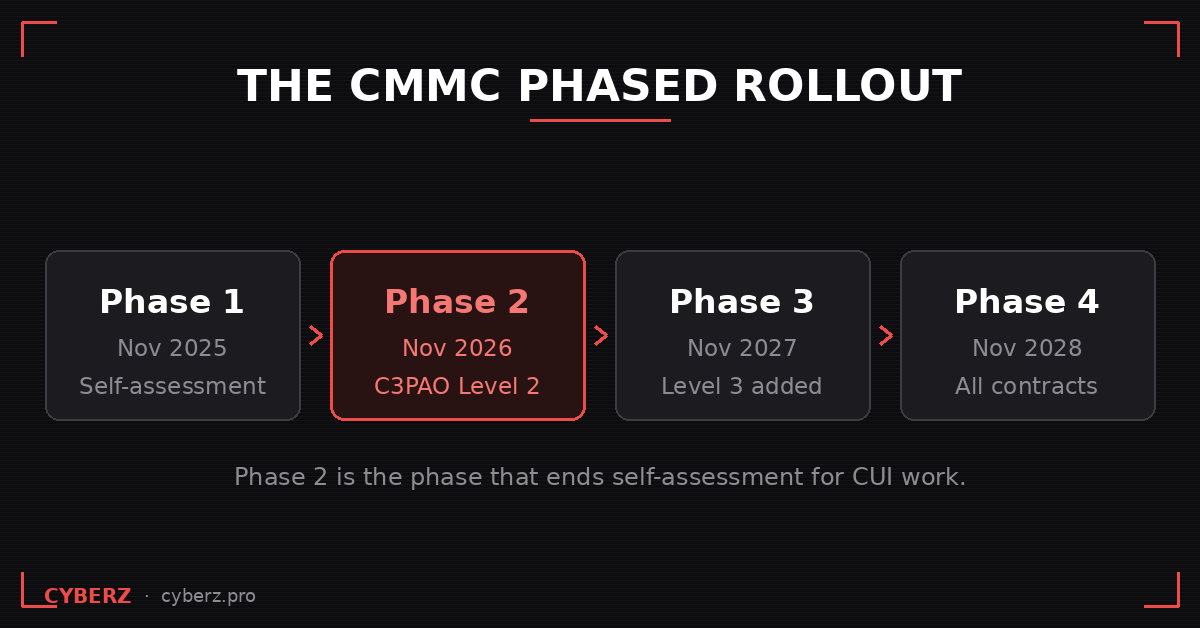
CMMC (Cybersecurity Maturity Model Certification) is the Department of Defense’s way of verifying that contractors actually protect the sensitive government information they handle. It rolls out in four annual phases, and November 10, 2026 is the start of Phase 2, not the finish line of anything.
The mechanics are set out by the DoD Chief Information Officer and codified in 32 CFR Part 170. Phase 1 ran from November 10, 2025, when contracting officers began including Level 1 and Level 2 self-assessment requirements in applicable solicitations as a condition of award. On November 10, 2026, Phase 2 begins, and mandatory Level 2 C3PAO certification becomes the standard for applicable contracts, meaning self-attestation is no longer sufficient for most contractors handling the relevant data on those contracts. Phase 3 follows on November 10, 2027, broadening Level 2 requirements and introducing Level 3 DIBCAC assessments for high-priority programs, and Phase 4 on November 10, 2028 represents full implementation.
The shift that matters in Phase 2 is the word “certification.” A C3PAO is a Certified Third-Party Assessment Organization, an independent assessor authorized to verify your security controls. Up to now, a Level 2 contractor could score themselves and post the result. After Phase 2 begins, for contracts involving Controlled Unclassified Information (CUI), an outside assessor has to confirm you actually meet all 110 controls in NIST SP 800-171.
Why November 10 is not a universal deadline
The most expensive misunderstanding in the market right now is treating that date as a switch that flips for every defense contractor at once. It does not. The requirement is contract-driven, not company-wide.
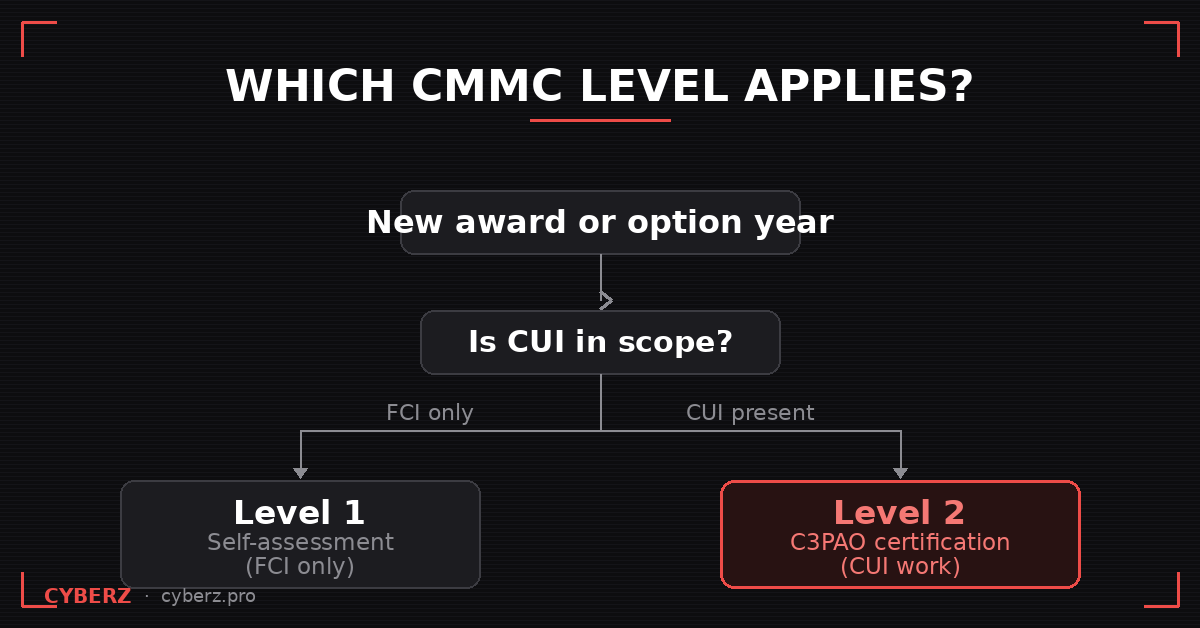
The regulation ties applicability to the data in a specific contract. Under 32 CFR Section 170.3(d)(2), the start of Phase 2 is not a blanket compliance deadline for all Defense Industrial Base contractors; it ties applicability to specific contract requirements, and the key term is “applicable,” determined by whether Federal Contract Information (FCI) or Controlled Unclassified Information (CUI) is present and how it is handled. In other words, the rollout is contract-by-contract. The certification requirement reaches you when it shows up in a solicitation you want to bid, a recompete, or an option year, as the contracting officer includes the clause.
That cuts two ways, and both matter for a small sub.
First, the date does not give you breathing room just because it is “in 2026.” A requirement can appear in your contracts before you expect it, and contracting officers already had discretion in Phase 1 to require C3PAO assessments on select Level 2 contracts. Primes are also pushing flow-down compliance demands down the chain well ahead of the deadline.
Second, the real exposure is not “missing a universal cutoff.” It is entering a solicitation or subcontract where Level 2 is already required and not being ready to compete. A missed bid does not come with a press release. It just quietly goes to a competitor who got certified first.
So the question is not “what do I do by November 10.” It is “which of my contracts and likely recompetes will carry this, and when.”
The bottleneck you are being warned about is not the one that will hurt you
The second story everywhere this year is the assessor shortage: not enough C3PAOs, year-long waitlists, you will be stuck in a queue. There is some truth to the wait times, but the data tells a more uncomfortable story for small contractors, and it points at a different problem.
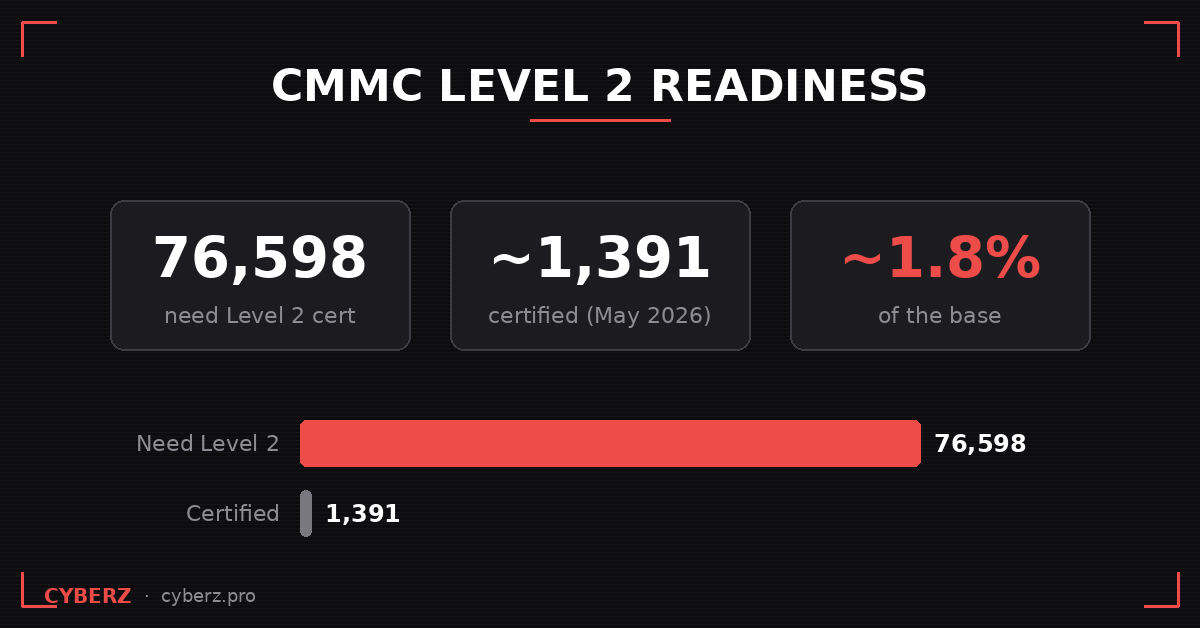
Here is the gap. The DoD estimates more than 76,000 organizations need Level 2 C3PAO certification; as of February 2026, fewer than 1,100 had completed it. By May 2026 that figure had risen to about 1,391 final Level 2 certifications, a new record, which still leaves the Defense Industrial Base at roughly 1 to 2 percent certified.
Now look at supply. As of the March 2026 Cyber AB Town Hall, there were 103 authorized C3PAOs and 759 Certified CMMC Assessors, yet only about 178 new Level 2 certificates were issued that month. If assessor availability were the true constraint, certification output would rise as the assessor pool grows. Instead the trendlines move independently, which signals the bottleneck is somewhere else: Defense Industrial Base readiness, not assessor supply.
Read together, that means the typical small contractor’s risk is not “I cannot find an assessor.” It is “I waited because I thought I had until 2027, and when the requirement landed, I was not ready to be assessed at all.” The assessors are not the wall. Your own readiness is.
The preparation timeline most small contractors underestimate
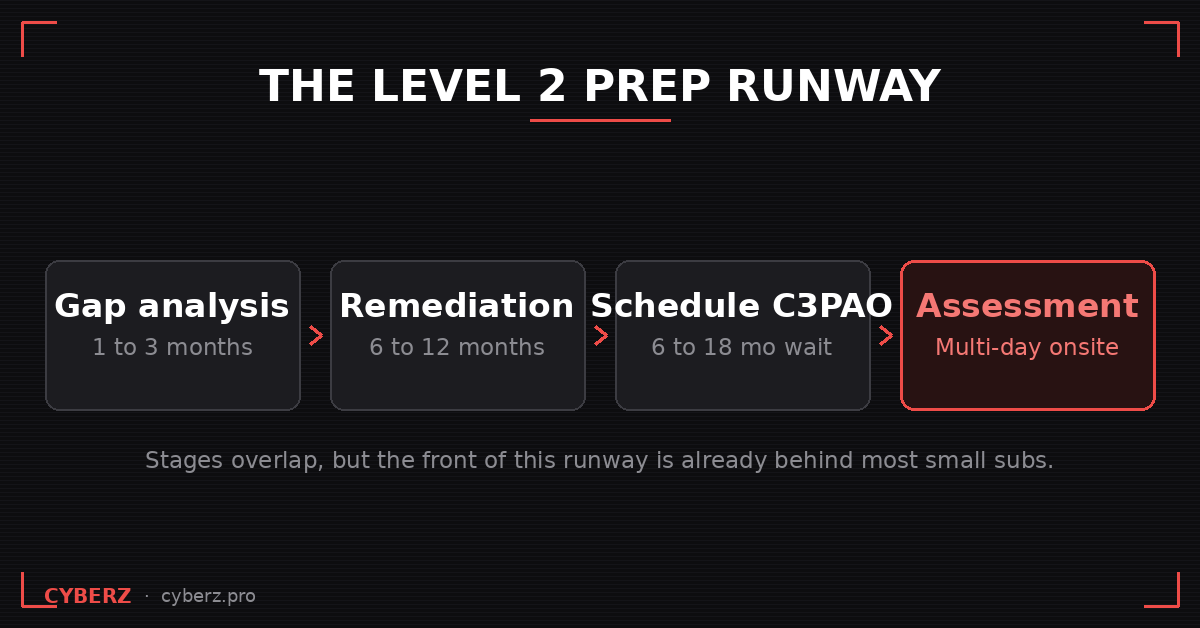
This is where the timing actually bites. Getting to a passable Level 2 posture is not a scheduling task you can knock out in a quarter. Gap analysis and remediation work, which come before the formal assessment, typically add 6 to 12 months to the total timeline. Then you still have to book the assessment and wait for the slot.
Plan it backward from the moment a requirement could realistically appear in one of your contracts, and the runway you thought you had shrinks fast.
What a Level 2 assessment actually checks
It helps to know what you are preparing for. CMMC Level 2 maps to the 110 security requirements in NIST SP 800-171 Revision 2, organized into 14 control families covering things like access control, identification and authentication, audit and accountability, incident response, and system and communications protection.
A C3PAO assessor scores each of the 110 against the assessment objectives in NIST SP 800-171A and marks it MET or NOT MET. To pass, you need a score of at least 88 of 110 (80 percent) with no prohibited open items on your Plan of Action and Milestones (POA&M). A POA&M is your documented plan to close a gap, and it is allowed only for certain lower-weight controls. Some requirements are weighted so heavily, or considered so fundamental, that they cannot be deferred to a POA&M at all and must be fully implemented before the assessment.
If you fall short but clear the threshold, you may receive a conditional certification, which opens a 180-day window to close the remaining POA&M items. Miss that window and the status expires, taking your eligibility with it. The two artifacts an assessor leans on most are your System Security Plan (SSP), the document describing how each control is implemented, and the evidence behind it. Thin or missing documentation is the single most common reason assessments stall.
One question that comes up constantly: does this mean Revision 3? Not yet. NIST has finalized SP 800-171 Revision 3, but the DoD has not authorized Revision 3 for CMMC scoring, SPRS reporting, or assessments. Revision 2 remains the required baseline, and the transition to Revision 3 is expected to take years through future rulemaking. Prepare to Revision 2 now, and watch for DoD guidance signaling the change.
Your SPRS score is a legal statement, not an IT metric
There is a piece of this that has nothing to do with assessors and everything to do with liability. Whatever score you self-report goes into the Supplier Performance Risk System (SPRS), and contracting officers check it before award.
That self-reported number is not just an IT metric. The Department of Justice has been treating inflated or false cybersecurity representations as False Claims Act violations. In January 2026, the DOJ announced it recovered $52 million through nine cybersecurity-related False Claims Act settlements in the fiscal year ending September 2025. The recurring pattern in those cases, including the MORSECORP settlement, is a contractor claiming a compliance posture it could not back up. The gap between your claimed SPRS score and your real one is the exposure, and a whistleblower, often a current or former employee, is usually what surfaces it. No breach required.
If you are not sure whether your self-reported posture would survive scrutiny, that is the thing to fix first, before it is the subject of a bid protest or a qui tam complaint. Our free False Claims Act exposure tool at falseclaimsrisk.com walks through where that risk sits, no signup.
What to do this quarter
For a 15-to-50-person contractor, the useful moves are concrete and none of them require waiting for November:
- Map your contracts. List current awards, likely recompetes, and option years, and flag which ones touch CUI versus FCI only. That tells you which will carry a Level 2 requirement and roughly when.
- Pull your real SPRS score. Re-run an honest self-assessment against all 110 NIST 800-171 controls and compare it to what is posted. If there is a gap, close the gap or fix the posting.
- Build or repair your System Security Plan. Missing or thin documentation is the most common reason assessments stall, so the SSP is where remediation actually starts.
- Get into the gap-analysis stage now. Six to twelve months of remediation does not start until you know what is broken.
- Ask your prime what they will require, and when. The flow-down letter you get this year is a preview of your real deadline.
Frequently asked questions
Is November 10, 2026 a hard deadline for all defense contractors? No. It is the start of CMMC Phase 2. Under 32 CFR 170.3(d)(2), the Level 2 C3PAO requirement applies “where applicable,” meaning it reaches you when it appears in a specific solicitation, recompete, or option year involving CUI, not on a single date for everyone.
Do I need a C3PAO assessment, or is a self-assessment enough? It depends on the data in the contract. Contracts involving only Federal Contract Information (FCI) generally call for a Level 1 self-assessment. Contracts involving Controlled Unclassified Information (CUI) require Level 2, and in Phase 2 that means third-party C3PAO certification for applicable contracts.
What score do I need to pass CMMC Level 2? At least 88 of 110 (80 percent) with no prohibited open items on your POA&M. Certain high-weight or fundamental controls cannot be placed on a POA&M and must be fully implemented before the assessment.
How long does CMMC Level 2 preparation take? Plan for 6 to 12 months of gap analysis and remediation before a formal assessment, plus scheduling and wait time for a C3PAO. Starting from scratch close to a known requirement date is usually not realistic.
What is the difference between FCI and CUI? FCI is information provided by or generated for the government under a contract that is not intended for public release. CUI is a broader category of sensitive government information that requires specific safeguarding, and its presence is what generally triggers the Level 2 requirement.
Does NIST 800-171 Revision 3 apply to CMMC yet? Not yet. NIST has finalized Revision 3, but the DoD has not authorized it for CMMC scoring, SPRS, or assessments. Revision 2 remains the baseline, and a formal transition is expected to take years.
The bottom line
November 10, 2026 is the start of Phase 2, not a universal cutoff, and the requirement reaches you contract by contract as CUI work comes up for award. The risk for a small contractor is not getting stuck behind an assessor queue. It is being unready when a requirement lands, and self-reporting a score you cannot defend in the meantime. The fix is to stop counting down to a date and start working backward from your own contracts and your own readiness.
If you want the full operational version, the CMMC 2.0 Compliance Survival Guide ($39) is the plain-English walkthrough built for small defense contractors. To work the controls directly, the NIST 800-171 Quick-Reference & Implementation Checklist ($29) covers all 110 controls across the 14 families.
Sources
- DoD Chief Information Officer, CMMC phased rollout schedule; 32 CFR Part 170 (including Section 170.3).
- Cyber AB Town Hall data (C3PAO and Certified CMMC Assessor counts, certification totals), February through May 2026.
- U.S. Department of Justice, FY2025 False Claims Act recovery announcement, January 2026.
- NIST SP 800-171 Revision 2 and SP 800-171A; NIST SP 800-171 Revision 3 (finalized, not yet authorized for CMMC).
Get CMMC deadline updates
Plain-English alerts when CMMC requirements, scoring, or deadlines change. Sent only when something actually moves.