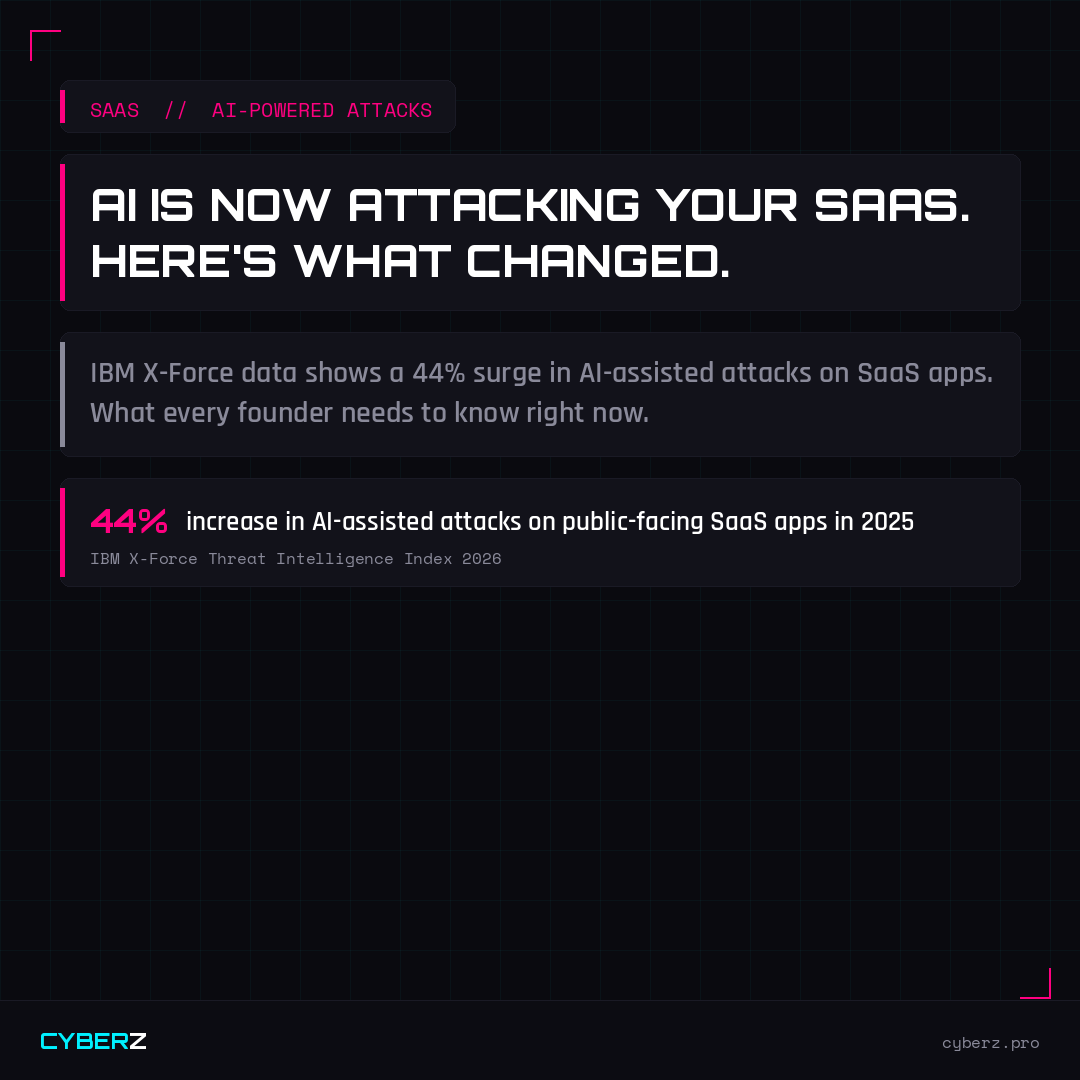
AI Is Now Attacking Your SaaS. Here's What Changed.
Marcus thought the email was from his lead investor.
Same name. Same tone. Even referenced a conversation they’d had on a call two weeks ago. It asked him to click a DocuSign link to approve a term sheet update before the weekend. He clicked it.
Three hours later, his AWS credentials were being used to spin up infrastructure in Singapore.
The attacker didn’t know Marcus personally. They used AI to scrape his LinkedIn, his company’s press releases, and his public investor updates — then generated a hyper-personalized phishing email in under 60 seconds. No human wrote it. No human sent it.
This is the new normal for SaaS companies in 2026.
What the IBM X-Force Report Actually Says
IBM’s 2026 X-Force Threat Intelligence Index, released last month, is one of the most data-rich threat reports in the industry. The headline findings aren’t subtle.
Attacks targeting public-facing applications — your login pages, your APIs, your OAuth endpoints — jumped 44% year over year. The primary driver: AI tools that let attackers scan for misconfigured access controls and missing authentication at a scale that was impossible even 18 months ago.
Supply chain and third-party compromises have quadrupled since 2020. For SaaS companies, that means the integrations you use — the Stripe webhooks, the Slack apps, the GitHub Actions — are increasingly the attack surface. Attackers aren’t breaking down your front door. They’re walking in through the vendor you added last quarter.
And vulnerability exploitation is now the leading cause of breaches, responsible for 40% of all incidents X-Force tracked in 2025.
Why SaaS Companies Are Ground Zero
You ship fast. You integrate everything. You have a small team wearing multiple hats. That’s your competitive advantage — and attackers know it.
A few structural realities that put SaaS startups in the crosshairs:
API sprawl. The average SaaS company has dozens of integrations, each with its own access token, webhook secret, or service account. Most of those were set up by a developer who left 18 months ago. Most are over-permissioned. AI-assisted scanners find them in minutes.
Identity is the new perimeter. Your employees use the same email for Slack, GitHub, Notion, and your AWS console. One compromised credential cascades into everything. IBM found that misconfigured access controls were the most common entry point in their penetration tests — not zero-days, not sophisticated exploits. Just credentials that were too powerful and too reused.
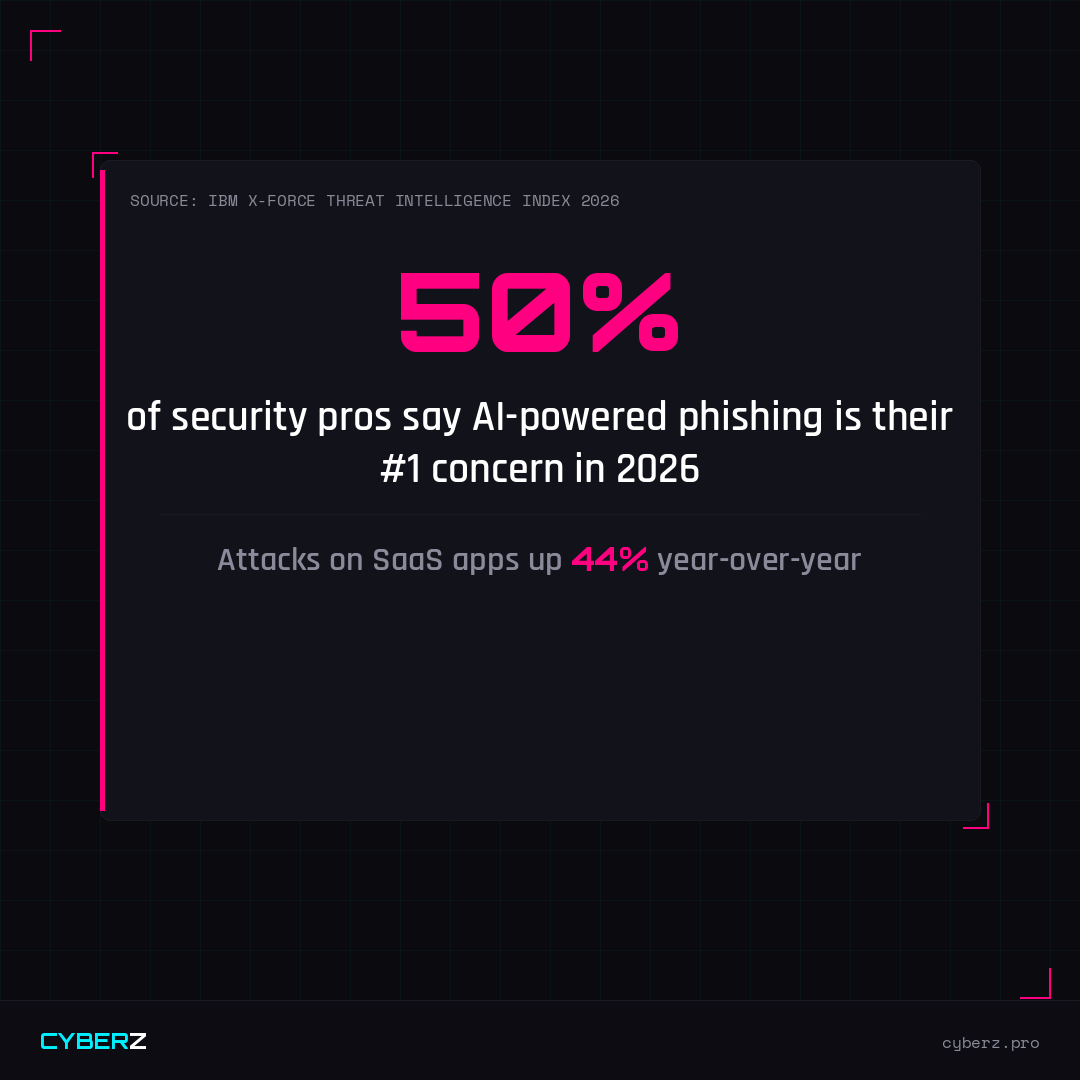
AI-generated phishing is now indistinguishable from real emails. The old tells — awkward phrasing, generic greetings, obvious pretexts — are gone. Attackers now use AI to scrape everything publicly available about your team and craft messages that reference real projects, real people, and real context. A 50% majority of security professionals in a recent survey ranked hyper-personalized AI phishing as their top concern for 2026.
What Actually Stops This
The good news: the defenses aren’t exotic. The same report that shows these numbers also shows that most breaches still come down to foundational gaps — things a 10-person team can fix this month.
1. Lock down your OAuth and API keys
Do a full audit of every API key, service account, and OAuth app connected to your environment. Revoke anything not actively used. Apply least-privilege to everything else. This single exercise closes more attack surface than any security tool you can buy.
2. MFA on everything, everywhere
Not optional, not “we’ll get to it.” Every engineer, every admin account, every customer-facing login. Hardware keys or app-based TOTP. SMS is better than nothing but is no longer considered secure against targeted attacks.
3. Treat phishing training like a product sprint
Your team needs to see what AI-generated phishing looks like today — not 2022-era examples. Run a simulated phishing campaign quarterly. The 15-minute investment per employee cuts click rates by over 60% in study after study.
4. Inventory your third-party integrations
You can’t protect what you can’t see. Build a list of every vendor, every integration, and the level of access each one has. If a vendor gets breached tomorrow, you need to know within an hour what data they had access to and how to revoke it.
// SAAS AI THREAT CHECKLIST — 2026
- Audit all API keys and OAuth apps — revoke anything unused or unrecognized
- Apply least-privilege to all service accounts and CI/CD pipeline credentials
- Enable MFA on every employee account, admin panel, and cloud console
- Run a phishing simulation with AI-generated examples in the next 30 days
- Document every third-party integration and its data access level
- Review and rotate GitHub Actions secrets and deployment tokens quarterly
- Enable login anomaly alerts — geography, device, time-of-day flags
- Ensure your incident response plan covers a compromised SaaS integration scenario
The Bigger Picture
AI hasn’t invented new types of attacks. Phishing, credential theft, and API abuse are not new. What AI has done is remove the capacity bottleneck that used to slow attackers down.
It used to take a dedicated attacker to craft a convincing spear-phishing email. Now it takes 60 seconds and a free API call. It used to take a skilled team to scan thousands of endpoints for misconfigurations. Now it’s a weekend script.
The asymmetry matters. Your team is finite. The tooling attackers have access to is not.
The SaaS companies that come out ahead aren’t necessarily the ones with the biggest security budgets. They’re the ones that treat security hygiene as a product discipline — something that ships with every sprint, not something bolted on after the breach.
SaaS Security Bundle
20+ security documents built for SaaS founders and dev teams — API security policies, SOC 2 prep, incident response plans, and phishing defense training built for fast-moving teams.
View Bundle →Originally reported by IBM X-Force Threat Intelligence Index 2026 for IBM X-Force Threat Intelligence Index 2026 on February 25, 2026.